

How Childhood Trauma Ages Us—and How Resilience Can Rewrite the Story
Jul 26 2026

What happens in childhood doesn’t stay in childhood at the cellular level, anyway. People who grow up in environments marked by trauma, neglect, or family dysfunction are more likely to face serious health challenges decades later, from heart disease and diabetes to depression and early death. This isn’t just a pattern seen in anecdotes, it’s a well-documented public health crisis. In one national survey, nearly two-thirds of U.S. adults reported at least one Adverse Childhood Experience (ACE), and about one in six had four or more [1].
The effects of those early experiences ripple through the lifespan. Adults with high ACE scores are significantly more likely to develop chronic illness, and studies have suggested that severe childhood trauma can trim as much as 10 to 20 years off life expectancy [2-4]. These are not rare or isolated cases; they reflect widespread patterns across broad demographic groups. Recent molecular studies add weight to these findings: longitudinal evidence shows that childhood maltreatment predicts faster epigenetic aging over time [5], ACEs have been linked to accelerated biological aging detectable as early as midlife [6], and even older adults carry these molecular scars, with early adversity tied to next-generation GrimAge and Pace of Aging clock acceleration [7].
Waiting for diseases to appear years or decades later is slow, expensive, and doesn't allow for early interventions. In the past decade, however, scientists have begun using tools that analyze molecular markers of biological aging.
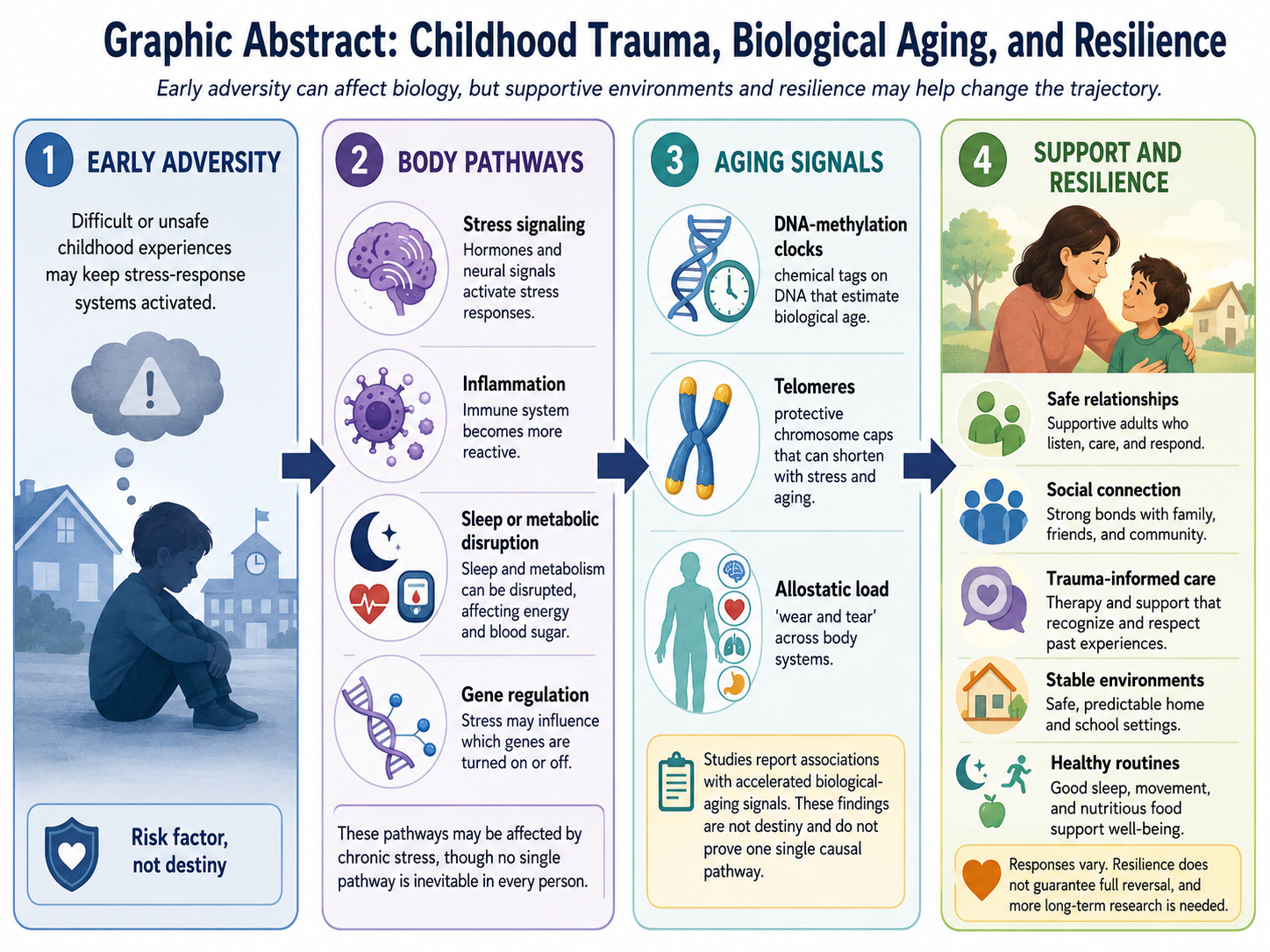
These tools, which include epigenetic clocks, telomere length, and composite stress scores known as allostatic load, read what’s happening inside the body, sometimes years before the first diagnosis. The most promising of these are DNA methylation clocks, which use patterns of chemical tags on DNA to estimate biological age. Some versions focus on how old a person’s epigenetics appear, while others track how fast they change. These clocks are now sensitive enough to detect the scars of childhood trauma and, increasingly, to measure how those scars might begin to heal.
Tools for Measuring Biological Aging
Inside the body, aging is a complex process, unfolding across dozens of systems, sometimes decades before we see visible signs. For people who’ve experienced serious childhood stress, this process seems to happen faster.
To study how that works, scientists now use biological markers that go far beyond the calendar. Among the most powerful are DNA methylation clocks, which estimate biological age based on chemical changes in the genome. These clocks work by analyzing DNA methylation, which acts like a regulatory layer on top of genes, influencing how active they are over time.
The first widely used clock, introduced by Steve Horvath in 2013, was able to estimate a person’s age across multiple tissues with impressive accuracy, usually within a few years [8]. While that first-generation clock was good at matching chronological age, it wasn’t always great at telling us about future health. That’s where newer clocks come in.
GrimAge, developed in 2019, is designed to predict not just age but mortality risk. It uses DNA methylation patterns tied to inflammation, smoking history, and disease-related proteins. Studies show that for every one-year increase in GrimAge acceleration, the risk of death rises by about nine percent.9 And importantly, people with high ACE scores—four or more—show biological ages on this clock that are 1.5 to 2 years older than their peers with less adversity. 7 That’s a change on par with chronic inflammation or diabetes.
DunedinPACE, does something different: it tracks the rate at which someone is aging. This clock doesn’t just ask “how old is the body right now?”, it asks “how quickly is this person getting older?” Developed using long-term health data from a New Zealand birth cohort, DunedinPACE has proven to be a strong predictor of future decline in physical function, facial aging, and mortality risk.10 And like GrimAge, it shows a clear association with childhood adversity—each 4-point increase in ACE score corresponds to about one year of added aging per calendar year. 7 Early research even suggests that the pace it measures might be slowed through mental health interventions. 11
Measuring aging in children brings its own challenges. Adult clocks aren’t designed to handle the rapid growth and developmental shifts of childhood and adolescence. That’s why researchers developed PedBE, a pediatric clock that works using cheek cell (buccal) samples. PedBE can estimate biological age from birth through early adulthood with striking accuracy—typically within four months.12 In early studies, it has picked up signs of accelerated aging in children whose mothers experienced high anxiety during pregnancy [13] as well as in children exposed to maltreatment and internalizing disorders like depression and anxiety [14].
Of course, the usefulness of any clock depends on how it’s measured. Most epigenetic aging studies use blood samples, which are highly reliable and consistent. Cheek swabs and saliva samples are easier to collect, especially in kids, but can vary more depending on cell types. Studies that use a single tissue type and adjust for cell composition tend to get the clearest results [15-17].
Beyond DNA methylation, researchers have also looked at telomeres—the protective caps at the ends of chromosomes. Telomeres shorten with each cell division and are sensitive to oxidative stress. People who’ve experienced early-life trauma tend to have shorter telomeres on average, though the effect is smaller than what’s seen with methylation clocks.18 Measuring telomeres can also be tricky: the most common technique, called qPCR, has a relatively high error rate,19 and results can vary significantly between individuals, even before trauma is factored in.9,20 That’s why telomeres are often treated as supporting evidence rather than the main readout.
A third way to assess biological aging is through allostatic load—a kind of composite stress score that adds up strain across systems like blood pressure, cholesterol, blood sugar, and hormone levels. Allostatic load reflects the “wear and tear” of chronic stress, including stress from childhood trauma. It has been linked to higher mortality risk in older adults21 and to increased anxiety and depression symptoms in children as young as nine.22 But gathering allostatic load data requires fasting blood draws and hormone testing, which makes it harder to scale—and harder to interpret.
When researchers compare these tools, epigenetic clocks stand out for their precision and predictive power. GrimAge and DunedinPACE, in particular, are sensitive to adversity and reliably track health outcomes. PedBE extends that power to children and teens, giving researchers a way to study aging before chronic illness takes hold. Telomeres and allostatic load still matter—they capture other layers of biology—but they’re often best used alongside methylation data rather than in place of it.9,10,12
Together, these tools are helping scientists understand how stress gets under the skin, long before the first symptoms appear.
What Research Shows About Trauma and the Aging Body
If early adversity speeds up the aging process, can we actually see it in the body? According to a growing number of studies, the answer is yes—and the effects show up earlier and more clearly than you might think.
In one major U.S. study of middle-aged adults, participants with high ACE scores—four or more—had GrimAge clocks that read nearly three-quarters of a year older than those with no ACEs.6 In another, older adults in Ireland who had experienced more early-life adversity showed even more pronounced changes: about two years of extra biological aging on GrimAge and more than one year on DunedinPACE. The data showed a consistent trend—each additional adversity was linked to a measurable uptick in biological age.7
This pattern has also been observed in other groups. Among African American adults in the U.S., researchers found that each standard-deviation increase in early-life adversity was linked to nearly a full year of GrimAge acceleration.23 These findings are remarkably consistent across different populations and age groups: more adversity, faster aging.
Evidence in children and adolescents is thinner but growing. One early clue comes from a German study of preschoolers with internalizing disorders like anxiety or depression. These children had higher PedBE scores—about 0.2 standard deviations faster than healthy controls—suggesting that psychological stress was already altering their biological aging trajectory.14
Meanwhile, DunedinPACE studies in youth have mostly focused on validating the clock itself rather than testing the impact of adversity. That means there’s still a gap in our understanding of how childhood trauma affects the pace of aging during adolescence. But based on what we’ve seen in adults—and on early results in children—it’s likely that these effects begin much earlier than we once thought.
Some of the most encouraging findings come from long-term studies that followed children over time to see how support and stability might influence biological aging. In one such study, rural Black families participated in a parenting program that aimed to improve communication and reduce household stress. Five years later, the children in the intervention group had aged more slowly on the Horvath clock—about 1.6 years less than their peers in the control group.24
A more recent study piloted a telehealth therapy program for preschoolers with developmental delays. While the sample was small, there was a trend toward slower PedBE acceleration twelve months after treatment, hinting that even short-term support might make a measurable biological difference.25
What’s still missing is large-scale, longitudinal research in teens and young adults—especially studies that track how adversity affects multiple clocks at once. But the data so far send a clear message: early trauma leaves an imprint not just on the mind, but on the molecular machinery of aging itself.
What Makes It Worse—Or Better
Childhood adversity might set the stage for accelerated aging, but it doesn’t act alone. The pace at which someone ages—biologically, not just chronologically—is shaped by a mix of internal biology and external environment. And while some of those effects make things worse, others open the door for healing.
One of the most influential factors is inflammation. Even in otherwise healthy adults, people with higher ACE scores tend to have more inflammation coursing through their bodies. A study of middle-aged adults with no major health problems found that higher levels of childhood trauma were linked to elevated levels of IL-6, IL-1β, and TNF-α—all key players in the body’s immune response.26
These patterns start surprisingly young. In one group of 6- to 8-year-olds, children exposed to household substance abuse or with four or more ACEs already had higher levels of inflammation, including CRP and IL-6.27 Among Hispanic children in the same study, CRP levels were significantly higher than in their Black and White peers—suggesting that both adversity and background may interact in complex ways. This kind of low-grade inflammation is more than a footnote. In long-term studies, elevated IL-6 and CRP in childhood have been linked to greater risk of depression and psychosis later in life.28
Although those studies didn’t directly measure epigenetic aging, newer research shows that the same inflammatory markers are linked to faster GrimAge and DunedinPACE scores. That positions inflammation as a likely mechanism connecting trauma to biological aging—a kind of silent engine that keeps the aging process running even after the original stressor is gone.
Stress hormones are another key link. The body’s central stress system—the hypothalamic-pituitary-adrenal (HPA) axis—helps regulate how we respond to threat. But when activated too often, or for too long, it can shift into overdrive. In one longitudinal study, adolescents who had faced greater early-life adversity had both higher cortisol levels in their hair (a long-term stress marker) and faster DunedinPACE aging at age 17.29Another study, this time in mothers caring for children with cancer, found that those who had experienced childhood trauma didn’t show the usual cortisol increases over the course of a stressful year. Instead, their cortisol levels stayed flat, a sign of chronic dysregulation—and they also had higher levels of inflammation.30
Sleep adds another piece to the puzzle. In a study of police officers, those with ACEs slept less efficiently and had more fragmented sleep—even after adjusting for other health and lifestyle factors .31 That may sound minor, but studies show that disrupted sleep is tied to faster aging on multiple clocks. In one large population study, women who woke up frequently during the night showed greater biological aging. In another, people with sleep apnea had GrimAge scores that were about half a year older than their peers.32
Exercise, or the lack of it, is also part of the picture. One study found that people who had experienced childhood trauma were less physically active in adulthood. This drop in activity was linked to symptoms of depression, and to increased fat around the heart—a known cardiovascular risk factor.33 But targeted exercise programs may help. In one small trial, young women with high ACE scores completed an eight-week aerobic and strength-training program. By the end, they had lower blood pressure and reduced levels of endothelin-1, a molecule associated with stress and vascular damage. Their cardiometabolic risk, measured using a DNA methylation-based score, also improved. Those who didn’t exercise showed no such change.34
And then there’s the social side. People with strong social ties—especially friendships—tend to age more slowly, biologically speaking. In a national study of older adults, those with more friend support and more frequent contact had slower DunedinPACE and lower GrimAge scores over a ten-year period.35 The effects were comparable to the benefits of maintaining a healthy body weight.
These findings all point to the same conclusion: the effects of early adversity are real and measurable, but they’re not fixed. Biology responds to the environment—not just during trauma, but afterward. Inflammation can be dialed down. Hormones can rebalance. Sleep, movement, and meaningful connection can all shift the trajectory. “Resilience isn’t luck—it’s built,” says Jacqueline Grace, CEO of Global Transformation Initiatives. “When kids feel safe and seen, their biology shifts. Schools can become either accelerators of stress or buffers against it, and that choice shows up years later in health outcomes.”
In other words, early stress changes the way we age—but it doesn’t have to write the ending.
Signs of Reversibility
One of the earliest glimpses came from a study in rural Georgia. Families were invited to take part in a parenting program designed to build communication and resilience in the face of adversity. The families that participated didn’t just report better relationships—the children, when followed over the next five years, showed slower biological aging. By age 20, their epigenetic age—measured by the Horvath clock—was 0.46 years younger than peers who hadn’t received the intervention.24 That may seem like a small difference, but when it comes to biological aging, even a fraction of a year can signal meaningful changes at the cellular level.
Another compelling case comes from Romania. In the Bucharest Early Intervention Project, young children raised in institutions were randomly placed into high-quality foster homes. Years later, those who were moved into nurturing environments had significantly longer telomeres than those who remained in institutional care. Longer telomeres suggest greater genomic stability and a slower pace of cellular aging.36
Exercise has shown particular promise as a biological reset button. In one study, young women who had experienced high levels of childhood adversity were randomly assigned to an eight-week program that combined aerobic and resistance training. Compared to a control group, they showed lower blood pressure, reduced levels of the inflammatory molecule endothelin-1, and improved scores on a DNA methylation–based risk index for heart disease.34 Even though this study didn’t directly use aging clocks like GrimAge or DunedinPACE, the biomarkers that improved—blood pressure, inflammation, metabolic risk—are exactly the ones those clocks respond to in other research.
Sleep, too, may help slow the clock. In a randomized trial involving older adults, researchers tested whether cognitive behavioral therapy for insomnia could influence biological aging. It did. After a year of treatment, the therapy group showed a measurable slowing in DunedinPACE—about 0.03 units, which translates to roughly four months of biological “youth” preserved for every calendar year. The control group, which received only sleep education, saw no such benefit.37
Together, these findings challenge the idea that early adversity sets an irreversible course. They don’t suggest that the damage disappears—but they do hint that the body is more flexible than we once thought. With the right kind of support—whether emotional, relational, physical, or behavioral—the biological scars of trauma may soften.
The research is still young. Most of these studies are small, and few have tracked multiple clocks at once. But the trend is encouraging. It suggests that the biology of adversity isn’t set in stone—and that change, however modest, is biologically measurable.
The biology of aging isn’t just about time—it’s also about experience. Across dozens of studies, scientists have shown that what happens in childhood can echo across decades, leaving traces not only in memory but in blood, genes, hormones, and immune cells.
People who face significant adversity early in life—neglect, abuse, household dysfunction—often show signs of faster biological aging later on. Advanced epigenetic clocks like GrimAge and DunedinPACE can detect this acceleration with surprising precision. In adults, high ACE scores often translate to one or two extra “biological years” for every four points of adversity.6,7 In children, newer clocks like PedBE are starting to reveal the same story, picking up accelerated aging even before puberty.14
The mechanisms behind this are becoming clearer. Chronic inflammation, disrupted stress hormones, fragmented sleep, and reduced physical activity all appear to drive this accelerated wear and tear.26–31,33,34 But just as important, social connection and resilience—particularly close friendships and supportive family environments—seem to buffer it.35 The biological pathways that carry stress into the body may also carry repair.
What’s perhaps most encouraging is the early evidence that biological aging isn’t fixed. Parenting interventions, trauma-informed therapy, regular exercise, and improved sleep have all shown signs of slowing or even reversing biological age in at-risk groups.24,34,37 These aren’t silver bullets—but they are proof of concept that healing isn’t just emotional or psychological. It’s cellular.
There’s still a long way to go. Most intervention studies are small, many don’t measure more than one clock, and diverse communities remain underrepresented in much of the research.38 But even with those gaps, the message is unmistakable: adversity leaves a mark—but that mark
is dynamic. It can deepen over time, or it can soften. And for those trying to understand how biology, experience, and resilience shape the arc of human health, the tools to track that story have never been more powerful.
We may not be able to change the past. But increasingly, we can measure its impact—and begin to change what happens next.
References
[1] Swedo EA, Aslam M V, Dahlberg LL, et al. Prevalence of Adverse Childhood Experiences Among U.S. Adults — Behavioral Risk Factor Surveillance System, 2011–2020. Vol 72.; 2023. PMID: 37384554.
[2] Felitti VJ, Anda RF, Nordenberg D, et al. Relationship of childhood abuse and household dysfunction to many of the leading causes of death in adults: The adverse childhood experiences (ACE) study. Am J Prev Med. 1998;14:245-258. PMID: 9635069.
[3] CDC. About the CDC-Kaiser ACE Study.
[4] Burke-Harris N. Roadmap for Resilience The California Surgeon General’s Report on Adverse Childhood Experiences, Toxic Stress, and Health.
[5] Chang OD, Meier HCS, Maguire-Jack K, Davis-Kean P, Mitchell C. Childhood Maltreatment and Longitudinal Epigenetic Aging: NIMHD Social Epigenomics Program. JAMA Netw Open. Published online July 2024:e2421877. PMID: 39073816.
[6] Kim K, Yaffe K, Rehkopf DH, et al. Association of Adverse Childhood Experiences With Accelerated Epigenetic Aging in Midlife. JAMA Netw Open. 2023;6. PMID: 37306997.
[7] McCrory C, Fiorito G, O’Halloran AM, Polidoro S, Vineis P, Kenny RA. Early life adversity and age acceleration at mid-life and older ages indexed using the next-generation GrimAge and Pace of Aging epigenetic clocks. Psychoneuroendocrinology. 2022;137. PMID: 34999481.
[8] Horvath S. DNA methylation age of human tissues and cell types. Genome Biol. 2013;14. PMID: 24138928.
[9] Lu AT, Quach A, Wilson JG, et al. DNA methylation GrimAge strongly predicts lifespan and healthspan. Aging. 2019;11:303-327. PMID: 30669119.
[10] Belsky DW, Caspi A, Corcoran DL, et al. DunedinPACE, A DNA methylation biomarker of the Pace of Aging. Elife. 2022;11. PMID: 35029144.
[11] Bourassa KJ, Garrett ME, Caspi A, et al. Posttraumatic stress disorder, trauma, and accelerated biological aging among post-9/11 veterans. Transl Psychiatry. 2024;14. PMID: 38184702.
[12] McEwen LM, O’Donnell KJ, McGill MG, et al. The PedBE clock accurately estimates DNA methylation age in pediatric buccal cells. Proc Natl Acad Sci U S A. 2020;117:23329-23335. PMID: 31611402.
[13] McGill MG, Pokhvisneva I, Clappison AS, et al. Maternal Prenatal Anxiety and the Fetal Origins of Epigenetic Aging. Biol Psychiatry. 2022;91:303-312. PMID: 34756561.
[14] Dammering F, Martins J, Dittrich K, et al. The pediatric buccal epigenetic clock identifies significant ageing acceleration in children with internalizing disorder and maltreatment exposure. Neurobiol Stress. 2021;15:100394. PMID: 34621920.
[15] Houseman EA, Accomando WP, Koestler DC, et al. DNA methylation arrays as surrogate measures of cell mixture distribution. BMC Bioinformatics. 2012;13.
[16] Pidsley R, Zotenko E, Peters TJ, et al. Critical evaluation of the Illumina MethylationEPIC BeadChip microarray for whole-genome DNA methylation profiling. Genome Biol. 2016;17. PMID: 27717381.
[17] Apsley AT, Ye Q, Caspi A, et al. Cross-tissue comparison of epigenetic aging clocks in humans. Aging Cell. 2025;24. PMID: 39780748.
[18] Ridout KK, Levandowski M, Ridout SJ, et al. Early life adversity and telomere length: A meta-analysis. Mol Psychiatry. 2018;23:858-871. PMID: 28322278.
[19] Lindrose AR, McLester-Davis LWY, Tristano RI, et al. Method comparison studies of telomere length measurement using qPCR approaches: A critical appraisal of the literature. PLoS One. 2021;16. PMID: 33471860.
[20] Kresovich JK, Parks CG, Sandler DP, Weinberg CR, Taylor JA. The Role of Blood Cell Composition in Epidemiologic Studies of Telomeres. Epidemiology. 2020;31:e34-e36. PMID: 32168019.
[21] Hwang AC, Peng LN, Wen YW, et al. Predicting all-cause and cause-specific mortality by static and dynamic measurements of allostatic load: A 10-year population-based cohort study in Taiwan. J Am Med Dir Assoc. 2014;15:490-496. PMID: 24631353.
[22] Finlay S, Juster RP, Adegboye O, Rudd D, McDermott B, Sarnyai Z. Childhood adversity, allostatic load, and adult mental health: Study protocol using the Avon Longitudinal Study of Parents and Children birth cohort. Front Psychiatry. 2023;13. doi:10.3389/fpsyt.2022.976140 PMID: 36683977.
[23] Simons RL, Ong ML, Lei MK, et al. Unstable Childhood, Adult Adversity, and Smoking Accelerate Biological Aging Among Middle-Age African Americans: Similar Findings for GrimAge and PoAm. J Aging Health. 2022;34:487-498. PMID: 34525884.
[24] Brody GH, Yu T, Chen E, Beach SRH, Miller GE. Family-centered prevention ameliorates the longitudinal association between risky family processes and epigenetic aging. J Child Psychol Psychiatry. 2016;57:566-574. PMID: 26680699.
[25] Merrill SM, Hogan C, Bozack AK, et al. Telehealth Parenting Program and Salivary Epigenetic Biomarkers in Preschool Children With Developmental Delay NIMHD Social Epigenomics Program. JAMA Netw Open. 2024;7. PMID: 39073812.
[26] Hartwell KJ, Moran-Santa Maria MM, Twal WO, et al. Association of elevated cytokines with childhood adversity in a sample of healthy adults. J Psychiatr Res. 2013;47:604-610. PMID: 23415658.
[27] Heard-Garris N, Davis MM, Estabrook R, et al. Adverse childhood experiences and biomarkers of inflammation in a diverse cohort of early school-aged children. Brain Behav Immun Health. 2020;1. PMID: 38377426.
[28] Khandaker GM, Pearson RM, Zammit S, Lewis G, Jones PB. Association of serum interleukin 6 and C-reactive protein in childhood with depression and psychosis in young adult life a population-based longitudinal study. JAMA Psychiatry. 2014;71:1121-1128. PMID: 25133871.
[29] Barr E, Comtois-Cabana M, Coope A, et al. Early-Life Adversity and Epigenetic Aging: Findings from a 17-Year Longitudinal Study. Biomolecules. 2025;15:887. PMID: 40563527.
[30] Marsland AL, Jones E, Reed RG, et al. Childhood trauma and hair cortisol response over the year following onset of a chronic life event stressor. Psychoneuroendocrinology. 2024;165. PMID: 38581748.
[31] Charles LE, Mnatsakanova A, Fekedulegn D, Violanti JM, Gu JK, Andrew ME. Associations of adverse childhood experiences (ACEs) with sleep duration and quality: the BCOPS study. Sleep Med. 2022;89:166-175. PMID: 35026653.
[32] Carroll JE, Prather AA. Sleep and biological aging: A short review. Curr Opin Endocr Metab Res. 2021;18:159-164. PMID: 34901521.
[33] Bertele S, Heitland I, Fraccarollo D, et al. Behavioral pathway to a broken heart: The link between adverse childhood experiences, depression, physical exercise and cardiovascular health. Front Psychiatry. 2022;13. PMID: 36304562.
[34] Rogers EM, Banks NF, Tomko PM, et al. Progressive exercise training improves cardiovascular psychophysiological outcomes in young adult women with a history of adverse childhood experiences. J Appl Physiol. 2023;134:742-752. PMID: 36727632.
[35] Hillmann AR, Dhingra R, Reed RG. Positive social factors prospectively predict younger epigenetic age: Findings from the Health and Retirement Study. Psychoneuroendocrinology. 2023;148. PMID: 36446244.
[36] Drury SS, Theall K, Gleason MM, et al. Telomere length and early severe social deprivation: Linking early adversity and cellular aging. Mol Psychiatry. 2012;17:719-727. PMID: 21577215.
[37] Carroll J. Cognitive Behavioral Treatment of Insomnia Slows the Pace of Biological Aging: Results from an RCT in Older Adults. Innov Aging. 2023;7:205-206.
[38] Watkins SH, Testa C, Chen JT, et al. Epigenetic clocks and research implications of the lack of data on whom they have been developed: A review of reported and missing sociodemographic characteristics. Environ Epigenet. 2023;9. PMID: 37564905.
Scientific & Medical Editorial Standards
Content published by LongevityWiz is developed and reviewed by qualified scientific and medical professionals, including experts holding doctorates in Bioengineering and Immunology and a physician who is a Fellow of the American College of Cardiology (FACC). Our editorial approach emphasizes scientific accuracy, peer-reviewed research, and evidence-based health information. Content is provided for educational purposes only and does not constitute individualized medical advice. Read our full Medical Disclaimer. LongevityWiz does not provide personalized healthcare guidance. Always consult a physician or other qualified healthcare professional before changing your diet, exercise routine, medications, supplements or overall healthcare plan. Never disregard professional medical advice or delay seeking treatment because of information you have read on this website.

