
How Childhood Trauma Ages Us—and How Resilience Can Rewrite the Story—Part One
Jul 26 2026
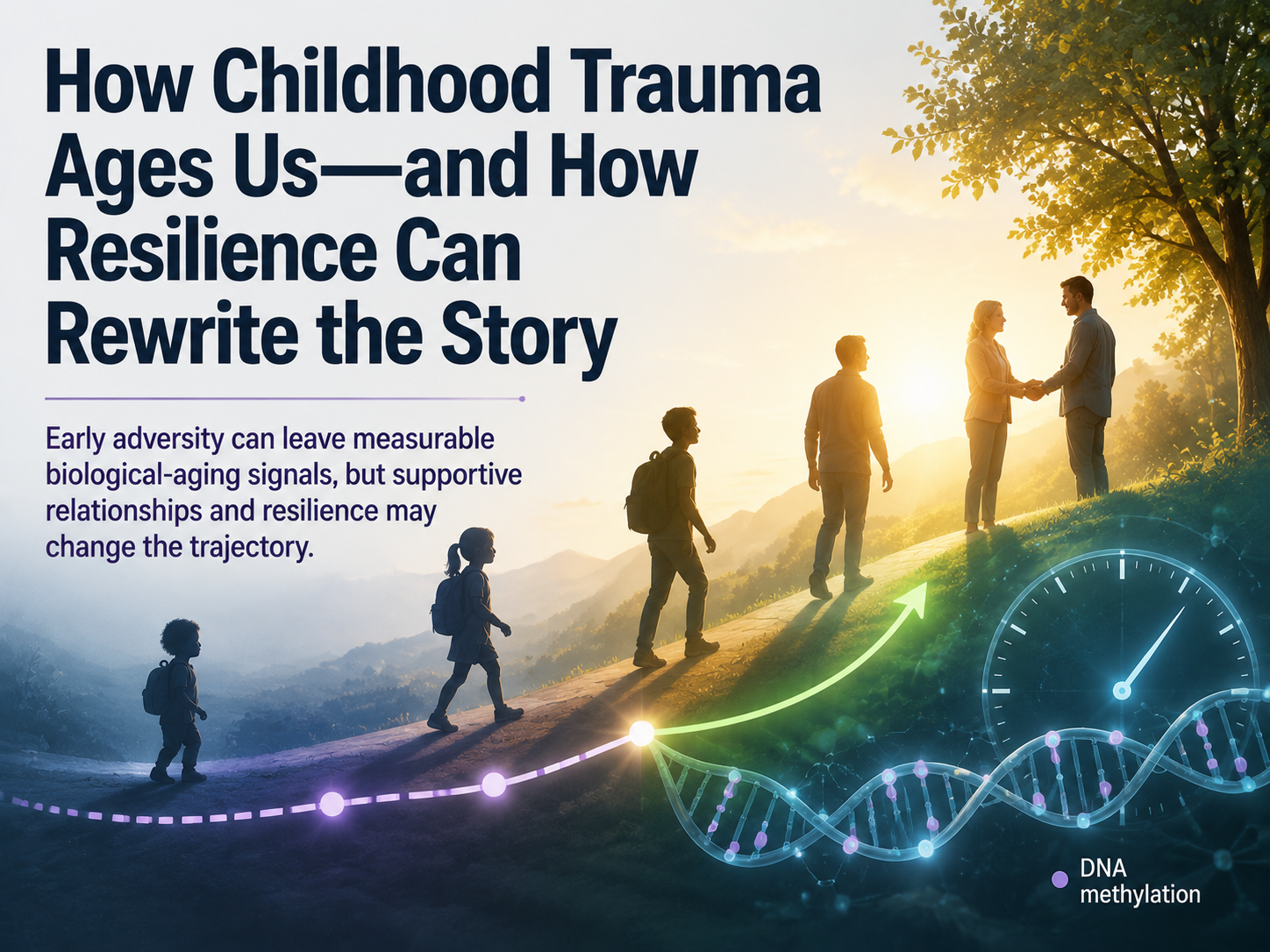
What happens in childhood doesn’t stay in childhood at the cellular level, anyway. People who grow up in environments marked by trauma, neglect, or family dysfunction are more likely to face serious health challenges decades later, from heart disease and diabetes to depression and early death. This isn’t just a pattern seen in anecdotes, it’s a well-documented public health crisis. In one national survey, nearly two-thirds of U.S. adults reported at least one Adverse Childhood Experience (ACE), and about one in six had four or more [1].
The effects of those early experiences ripple through the lifespan. Adults with high ACE scores are significantly more likely to develop chronic illness, and studies have suggested that severe childhood trauma can trim as much as 10 to 20 years off life expectancy [2-4]. These are not rare or isolated cases; they reflect widespread patterns across broad demographic groups. Recent molecular studies add weight to these findings: longitudinal evidence shows that childhood maltreatment predicts faster epigenetic aging over time [5], ACEs have been linked to accelerated biological aging detectable as early as midlife [6], and even older adults carry these molecular scars, with early adversity tied to next-generation GrimAge and Pace of Aging clock acceleration [7].
Waiting for diseases to appear years or decades later is slow, expensive, and doesn't allow for early interventions. In the past decade, however, scientists have begun using tools that analyze molecular markers of biological aging.
These tools, which include epigenetic clocks, telomere length, and composite stress scores known as allostatic load, read what’s happening inside the body, sometimes years before the first diagnosis. The most promising of these are DNA methylation clocks, which use patterns of chemical tags on DNA to estimate biological age. Some versions focus on how old a person’s epigenetics appear, while others track how fast they change. These clocks are now sensitive enough to detect the scars of childhood trauma and, increasingly, to measure how those scars might begin to heal.
Tools for Measuring Biological Aging
Inside the body, aging is a complex process, unfolding across dozens of systems, sometimes decades before we see visible signs. For people who’ve experienced serious childhood stress, this process seems to happen faster.
To study how that works, scientists now use biological markers that go far beyond the calendar. Among the most powerful are DNA methylation clocks, which estimate biological age based on chemical changes in the genome. These clocks work by analyzing DNA methylation, which acts like a regulatory layer on top of genes, influencing how active they are over time.
The first widely used clock, introduced by Steve Horvath in 2013, was able to estimate a person’s age across multiple tissues with impressive accuracy, usually within a few years [8]. While that first-generation clock was good at matching chronological age, it wasn’t always great at telling us about future health. That’s where newer clocks come in.
GrimAge, developed in 2019, is designed to predict not just age but mortality risk. It uses DNA methylation patterns tied to inflammation, smoking history, and disease-related proteins. Studies show that for every one-year increase in GrimAge acceleration, the risk of death rises by about nine percent.9 And importantly, people with high ACE scores—four or more—show biological ages on this clock that are 1.5 to 2 years older than their peers with less adversity. 7 That’s a change on par with chronic inflammation or diabetes.
DunedinPACE, does something different: it tracks the rate at which someone is aging. This clock doesn’t just ask “how old is the body right now?”, it asks “how quickly is this person getting older?” Developed using long-term health data from a New Zealand birth cohort, DunedinPACE has proven to be a strong predictor of future decline in physical function, facial aging, and mortality risk.10 And like GrimAge, it shows a clear association with childhood adversity—each 4-point increase in ACE score corresponds to about one year of added aging per calendar year. 7 Early research even suggests that the pace it measures might be slowed through mental health interventions. 11
Measuring aging in children brings its own challenges. Adult clocks aren’t designed to handle the rapid growth and developmental shifts of childhood and adolescence. That’s why researchers developed PedBE, a pediatric clock that works using cheek cell (buccal) samples. PedBE can estimate biological age from birth through early adulthood with striking accuracy—typically within four months.12 In early studies, it has picked up signs of accelerated aging in children whose mothers experienced high anxiety during pregnancy [13] as well as in children exposed to maltreatment and internalizing disorders like depression and anxiety [14].
Of course, the usefulness of any clock depends on how it’s measured. Most epigenetic aging studies use blood samples, which are highly reliable and consistent. Cheek swabs and saliva samples are easier to collect, especially in kids, but can vary more depending on cell types. Studies that use a single tissue type and adjust for cell composition tend to get the clearest results [15-17].
Beyond DNA methylation, researchers have also looked at telomeres—the protective caps at the ends of chromosomes. Telomeres shorten with each cell division and are sensitive to oxidative stress. People who’ve experienced early-life trauma tend to have shorter telomeres on average, though the effect is smaller than what’s seen with methylation clocks.18 Measuring telomeres can also be tricky: the most common technique, called qPCR, has a relatively high error rate,19 and results can vary significantly between individuals, even before trauma is factored in.9,20 That’s why telomeres are often treated as supporting evidence rather than the main readout.
A third way to assess biological aging is through allostatic load—a kind of composite stress score that adds up strain across systems like blood pressure, cholesterol, blood sugar, and hormone levels. Allostatic load reflects the “wear and tear” of chronic stress, including stress from childhood trauma. It has been linked to higher mortality risk in older adults21 and to increased anxiety and depression symptoms in children as young as nine.22 But gathering allostatic load data requires fasting blood draws and hormone testing, which makes it harder to scale—and harder to interpret.
When researchers compare these tools, epigenetic clocks stand out for their precision and predictive power. GrimAge and DunedinPACE, in particular, are sensitive to adversity and reliably track health outcomes. PedBE extends that power to children and teens, giving researchers a way to study aging before chronic illness takes hold. Telomeres and allostatic load still matter—they capture other layers of biology—but they’re often best used alongside methylation data rather than in place of it.9,10,12
Together, these tools are helping scientists understand how stress gets under the skin, long before the first symptoms appear.
What Research Shows About Trauma and the Aging Body
If early adversity speeds up the aging process, can we actually see it in the body? According to a growing number of studies, the answer is yes—and the effects show up earlier and more clearly than you might think.
In one major U.S. study of middle-aged adults, participants with high ACE scores—four or more—had GrimAge clocks that read nearly three-quarters of a year older than those with no ACEs.6 In another, older adults in Ireland who had experienced more early-life adversity showed even more pronounced changes: about two years of extra biological aging on GrimAge and more than one year on DunedinPACE. The data showed a consistent trend—each additional adversity was linked to a measurable uptick in biological age.7
This pattern has also been observed in other groups. Among African American adults in the U.S., researchers found that each standard-deviation increase in early-life adversity was linked to nearly a full year of GrimAge acceleration.23 These findings are remarkably consistent across different populations and age groups: more adversity, faster aging.
Evidence in children and adolescents is thinner but growing. One early clue comes from a German study of preschoolers with internalizing disorders like anxiety or depression. These children had higher PedBE scores—about 0.2 standard deviations faster than healthy controls—suggesting that psychological stress was already altering their biological aging trajectory.14
Meanwhile, DunedinPACE studies in youth have mostly focused on validating the clock itself rather than testing the impact of adversity. That means there’s still a gap in our understanding of how childhood trauma affects the pace of aging during adolescence. But based on what we’ve seen in adults—and on early results in children—it’s likely that these effects begin much earlier than we once thought.
Some of the most encouraging findings come from long-term studies that followed children over time to see how support and stability might influence biological aging. In one such study, rural Black families participated in a parenting program that aimed to improve communication and reduce household stress. Five years later, the children in the intervention group had aged more slowly on the Horvath clock—about 1.6 years less than their peers in the control group.24
A more recent study piloted a telehealth therapy program for preschoolers with developmental delays. While the sample was small, there was a trend toward slower PedBE acceleration twelve months after treatment, hinting that even short-term support might make a measurable biological difference.25
What’s still missing is large-scale, longitudinal research in teens and young adults—especially studies that track how adversity affects multiple clocks at once. But the data so far send a clear message: early trauma leaves an imprint not just on the mind, but on the molecular machinery of aging itself.

