

The 156-Year Thought Experiment: What Somatic Mutations May Mean for Human Lifespan
Jul 31 2026
A mathematical model asks how long humans might survive if somatic mutations were the only remaining hallmark of aging.
Imagine that aging is a building occupied by twelve vandals. Through some triumph of future medicine, eleven are escorted out. Telomeres behave, mitochondria stop sulking, inflammation lowers its voice, and senescent cells finally leave the party. One vandal remains: somatic mutation, the slow accumulation of DNA changes in the cells of the body. How long would the building stand?
A 2026 paper in npj Aging turns that impossible experiment into a mathematical model. Its answer is arresting: when the researchers modeled somatic mutations as the only remaining hallmark of aging, median lifespan fell from a theoretical non-aging baseline of 1,759 years to about 156 years. Depending on assumptions about how organs fail together, the median ranged from 146 to 194 years [1]. This is not a prediction that anyone will reach 156. It is an attempt to estimate how much one form of molecular damage might matter after nearly everything else has been imagined away.
What is a somatic mutation?
Somatic mutations are DNA changes acquired after conception in ordinary body cells. They are not necessarily inherited by children, and most do not turn a cell into a tumor. Some are harmless passengers. Others interfere with a gene, kill a cell, or help a mutant cell clone outcompete its neighbors. Genomic instability is only one of twelve interconnected hallmarks in the modern framework of aging [2]. That word interconnected matters. Biology has an irritating habit of refusing to keep its mechanisms in separate filing cabinets.
There is good evidence that mutation accumulation tracks with aging. In a landmark comparison of 16 mammal species, investigators sequenced 208 intestinal crypts from 56 individuals. Species with longer lifespans accumulated somatic mutations more slowly, and the estimated mutation burden near the end of life varied surprisingly little across species [3]. In human brain tissue, single-neuron sequencing found that mutations increased roughly linearly with age and accumulated faster in the hippocampus than in the prefrontal cortex [4]. Association, however, is not the same thing as a stopwatch that determines death.
Why the brain and heart become the bottlenecks
The new model focuses on a basic asymmetry. Tissues such as the liver and airway lining maintain pools of dividing cells that can replace damaged cells. Neurons and cardiomyocytes, by contrast, are treated as largely post-mitotic: many must survive and function for decades without routine wholesale replacement. If a critical liver cell is lost, a replacement program can often be summoned. If enough essential neurons or heart-muscle cells are lost, the body cannot simply place a reorder.
Using published mutation rates, estimates of lethal mutations, organ cell numbers, and variation in functional reserve, the authors modeled failure in neurons, cardiomyocytes, hepatocytes, and airway basal cells. Proliferating tissues remained functional for thousands of modeled years because replacement diluted the damage. The brain and heart set much shorter limits. When the organs were combined, the median settled near 156 years under the main independence assumption; dependence bounds produced the wider 146-to-194-year range [1].
This tissue contrast is biologically useful even if the century estimates prove wrong. Mutation is not merely a matter of how many spelling errors exist in the genome. Consequences depend on which cell carries the error, which gene is affected, whether the cell divides, whether a clone expands, and whether the tissue can replace what is lost. Blood offers a real-world example: age-related mutant blood-cell clones, called clonal hematopoiesis, have been associated with substantially higher coronary heart disease risk, and experimental work suggests that some mutations can promote vascular inflammation [5].
Why 1,759 years is not a secret forecast
The 1,759-year baseline is what happens when the model freezes all-cause mortality at the level observed around age 30 and removes age-related increases in risk. It is a mathematical control condition, not a hidden human lifespan waiting to be unlocked by the correct supplement stack. The model also defines maximum lifespan as the age at which survival falls to one person in 100,000. That operational definition is useful for equations, but it is not a newly discovered biological expiration date.
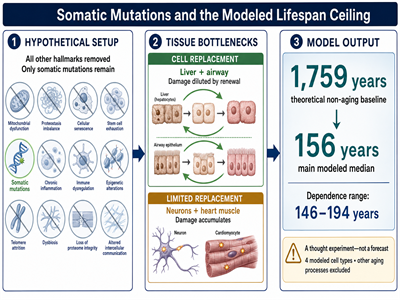
Likewise, 156 years is not the model's estimate of what current medicine can deliver. The calculation assumes that every other hallmark of aging has been eliminated, that mutation rates continue as specified, that no future treatment reduces mutation accumulation, and that organs fail according to simplified statistical relationships. It includes only four modeled cell types. Cancer beyond the frozen background mortality, nonlethal mutations that quietly degrade function, clonal expansion, organ-to-organ signaling, immune effects, transplantation, and many other complications are absent or greatly simplified.
The hardest question: do mutations drive ordinary aging?
Here the scientific plot becomes more interesting than the number on the cover. Somatic mutations unquestionably cause cancer and can damage cells. The unsettled question is whether the mutation burdens measured in normal tissues are sufficient to explain the broad, gradual deterioration of ordinary aging. A 2024 review argued that, outside important exceptions such as cancer, current sequencing data and inherited mutation disorders do not yet support somatic mutations as the dominant driver of most aging phenotypes [6].
The new paper reaches a more nuanced destination than its dramatic arithmetic suggests. Somatic mutations can impose a meaningful ceiling in the model, yet they still cannot reproduce the mortality we actually observe. Even after mutation damage is allowed to do its worst, modeled median survival remains roughly twice today's human longevity. The authors therefore infer that other aging processes must contribute comparably. In other words, the remaining vandal is destructive, but apparently did not wreck the building alone.
What the model can and cannot prove
This study cannot be tested in the ordinary way because no human population ages with every hallmark except somatic mutation switched off. It is closer to a disciplined counterfactual: specify assumptions, connect data from multiple tissues, and ask what follows. Its value is not that the exact answer must be 156. Its value is that the model exposes which assumptions matter, highlights post-mitotic tissues as potential bottlenecks, and gives researchers a framework that can be revised as mutation-rate and cell-survival data improve.
The broader human lifespan debate remains unresolved. A demographic analysis published in 2016 argued that maximum lifespan had plateaued and was naturally constrained [7]. Other researchers have disputed whether such data establish a fixed limit. The new mutation model does not settle that argument because it asks a different question: not how long humans presently live, but how long a hypothetical population might survive when almost all age-related causes of rising mortality are removed.
What this means for longevity medicine
No clinical test can convert this paper into an individual lifespan estimate, and no approved therapy can erase a lifetime of somatic mutations from every tissue. Strategies that reduce mutagen exposure remain sensible for well-established reasons: avoid tobacco, limit unnecessary ultraviolet exposure, use recommended cancer screening, and reduce exposure to known carcinogens. Those actions lower disease risk; they are not tickets to a modeled 156th birthday.
For research, the study points toward harder questions. Can vulnerable long-lived cells improve DNA repair without increasing cancer risk? Can damaged cells be replaced, reprogrammed, or supported without disturbing tissue architecture? Can harmful clones be detected and controlled before they dominate? And can interventions address several hallmarks at once, since the hallmarks continually interact?
The most honest reading is therefore neither "humans can live 156 years" nor "mutations do not matter." It is this: even in an extravagantly favorable imaginary world, the genome keeps accumulating history. The model suggests that this history could eventually constrain the brain and heart, while also showing that mutation alone cannot explain why humans age as rapidly as we do. The number is memorable. The more important result is that aging remains a systems problem, and systems problems rarely surrender to a single elegant fix.
References
[1] Efimov E, Fedotov V, Malaev L, Khrameeva EE, Kriukov D. Somatic mutations impose an entropic upper bound on human lifespan. npj Aging. 2026. doi:10.1038/s41514-026-00421-6.
[2] López-Otín C, Blasco MA, Partridge L, Serrano M, Kroemer G. Hallmarks of aging: An expanding universe. Cell. 2023;186(2):243-278. doi:10.1016/j.cell.2022.11.001.
[3] Cagan A, Baez-Ortega A, Brzozowska N, et al. Somatic mutation rates scale with lifespan across mammals. Nature. 2022;604(7906):517-524. doi:10.1038/s41586-022-04618-z.
[4] Lodato MA, Rodin RE, Bohrson CL, et al. Aging and neurodegeneration are associated with increased mutations in single human neurons. Science. 2018;359(6375):555-559. doi:10.1126/science.aao4426.
[5] Jaiswal S, Natarajan P, Silver AJ, et al. Clonal Hematopoiesis and Risk of Atherosclerotic Cardiovascular Disease. N Engl J Med. 2017;377(2):111-121. doi:10.1056/NEJMoa1701719.
[6] Chatsirisupachai K, de Magalhães JP. Somatic mutations in human ageing: New insights from DNA sequencing and inherited mutations. Ageing Res Rev. 2024;96:102268. doi:10.1016/j.arr.2024.102268.
[7] Dong X, Milholland B, Vijg J. Evidence for a limit to human lifespan. Nature. 2016;538(7624):257-259. doi:10.1038/nature19793.

