

Uric Acid and Longevity: The Antioxidant Paradox Hidden Behind Gout
Jul 26 2026
Edited and Approved by Stephen C. Rose, PhD, MS
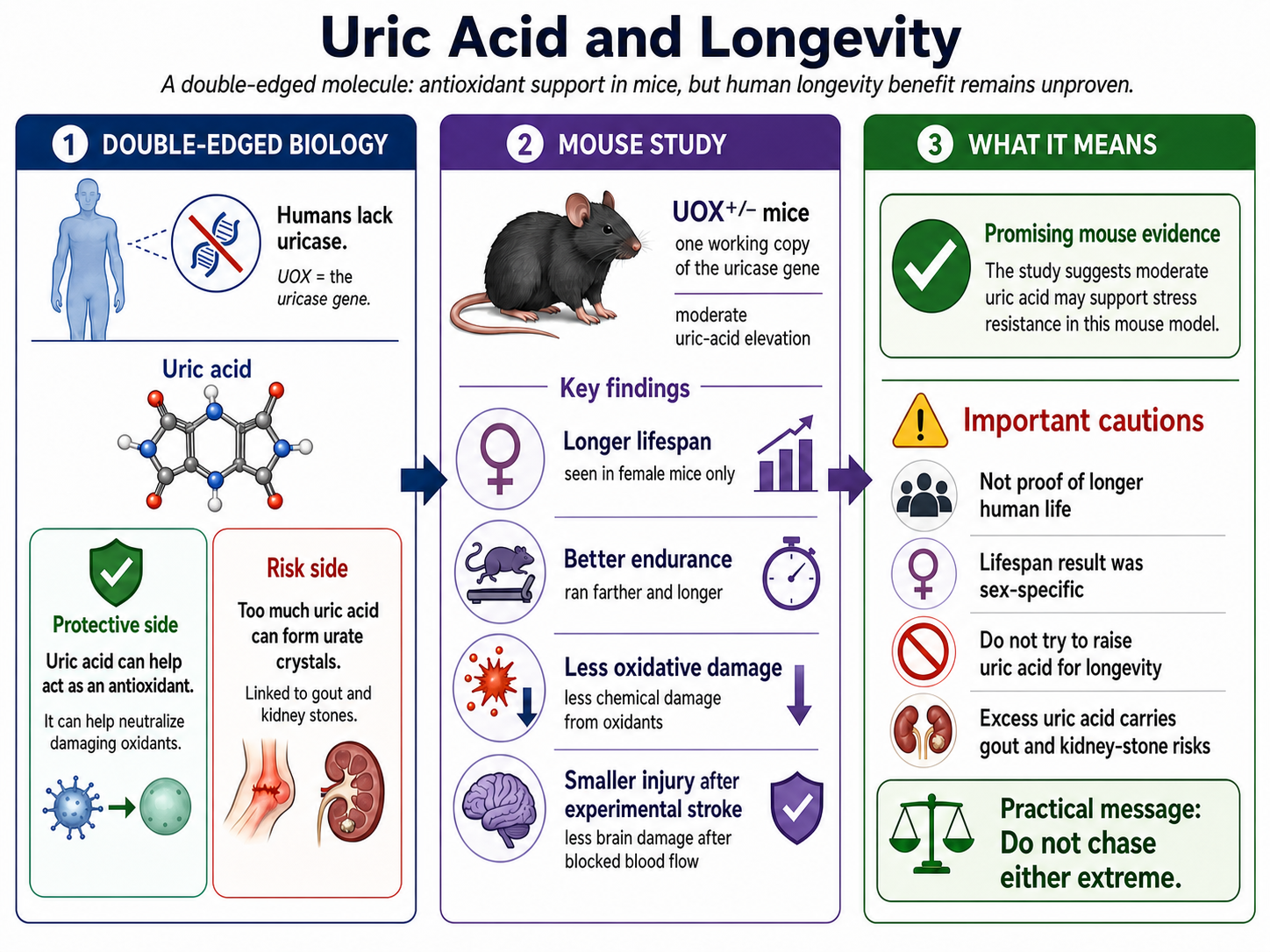
Uric acid has a public-relations problem. Most people meet it through gout, kidney stones, or a laboratory result their doctor wants to lower. Yet uric acid is also one of the most abundant antioxidants circulating in human blood. In a provocative mouse study, a moderate rise in uric acid was linked to longer life in females, greater running endurance, and less brain damage after an experimental stroke [1]. That sounds like a longevity breakthrough. It is not. It is a carefully controlled animal experiment that exposes a genuine biological paradox.
The study helps explain why uric acid cannot be sorted neatly into "good" or "bad." At physiological concentrations it may help neutralize damaging oxidants. At higher concentrations, or in the wrong metabolic setting, it can crystallize and contribute to disease. The useful question is therefore not whether everyone should raise or lower uric acid. It is what the study actually demonstrated, how well those findings translate to humans, and why balance matters more than maximizing a single blood marker.
Why humans carry so much uric acid
Uric acid is the end product of purine metabolism in humans. Most mammals continue the process with an enzyme called urate oxidase, or uricase, which converts uric acid into allantoin. Humans and other great apes lost functional uricase during evolution, so our circulating uric acid is much higher than that of most mammals. One influential hypothesis proposed that this retained uric acid partly compensates for the loss of vitamin C synthesis by strengthening antioxidant defense [2]. That idea is biologically plausible, but it is not proof that higher uric acid makes humans live longer.
Uric acid can scavenge peroxynitrite and hydroxyl radicals in extracellular fluids. Those reactive molecules can damage proteins, lipids, and DNA. The chemistry gives uric acid a credible protective role, especially during intense metabolic stress. But the same molecule becomes troublesome when its concentration exceeds its solubility or when kidneys cannot clear it effectively. Monosodium urate crystals can then form in joints, producing gout, and urate-related stones can develop in the urinary tract. Biology often reuses the same molecule as both shield and hazard.
What the mouse experiment actually tested
Roy Cutler and colleagues studied mice with different amounts of functional uricase. Wild-type mice had two working copies of the Uox gene. Heterozygous UOX+/- mice had one working copy and developed an approximately fivefold age-related rise in uric acid. Mice lacking both copies had much higher levels and required allopurinol to prevent kidney failure and early death. This design allowed the researchers to compare low, moderate, and more extreme uric-acid exposure while tracking lifespan, exercise performance, oxidative damage, and stroke recovery [1].
The longevity result was sex-specific. Female UOX+/- mice lived significantly longer than wild-type females, but male UOX+/- mice did not outlive wild-type males. Complete uricase deficiency did not extend lifespan; male UOX-/- mice actually had shorter lives. The study therefore did not show a simple "more uric acid, more longevity" relationship. It showed that one genetic model of moderate, gradually rising uric acid extended life in female mice under laboratory conditions. Why females benefited and males did not remains uncertain [1].
Endurance and brain protection were more consistent
During treadmill exercise, uric acid rose in the UOX+/- mice but not in wild-type animals. The heterozygous mice ran farther and longer, with female mice showing a particularly large difference. Their muscle tissue also showed less protein nitration after strenuous running. These findings support the idea that uric acid can buffer some oxidative stress during exertion. They do not establish that uric-acid supplements improve human athletic performance; the intervention was genetic, the subjects were mice, and motivation as well as muscle biology may have influenced treadmill behavior [1].
The researchers also temporarily blocked blood flow through a cerebral artery to model ischemic stroke. UOX+/- mice had smaller infarcts and better neurological scores, along with less oxidative protein damage. Brain-derived neurotrophic factor, a protein involved in neuronal survival and plasticity, was higher in their brains. This is compelling preclinical evidence that endogenous uric acid can participate in stress resistance. It does not mean that chronic hyperuricemia prevents stroke, nor that uric acid should be administered outside a clinical trial [1].
Human longevity data look more like a U than a ladder
Observational studies in people complicate the story. In a cohort of 375,163 South Korean adults, both very low and very high uric-acid levels were associated with greater all-cause, cardiovascular, and cancer mortality. The lowest-risk range sat between the extremes, producing a U-shaped curve [3]. This finding is observational, not causal. Low uric acid can reflect poor nutrition, illness, medication use, or other conditions, while high uric acid often travels with kidney dysfunction, obesity, hypertension, insulin resistance, and diuretic use. Adjustment cannot remove every source of confounding.
A small clinical signal has appeared in acute stroke. In a prespecified analysis of the URICO-ICTUS randomized trial, adding intravenous uric acid to clot-dissolving treatment improved outcomes in women but not men [4]. That sex difference is intriguing beside the female-only lifespan result in mice, but it remains preliminary. It involved short-term treatment during a medical emergency, not sustained elevation for healthy aging. It should not be generalized into a recommendation to increase uric acid chronically.
When promising biology meets randomized trials
Randomized trials are especially useful here because they test whether deliberately changing uric acid changes disease. In the SURE-PD3 trial, 298 people with early Parkinson disease received inosine or placebo. Inosine raised serum urate by about 2 mg/dL, but it did not slow clinical progression or preserve dopamine-transporter imaging. The trial stopped early for futility, and kidney stones occurred more often with inosine [5]. Strong observational and mechanistic clues therefore failed to become a useful treatment.
Lowering uric acid has not produced a universal longevity benefit either. In ALL-HEART, 5,721 older adults with ischemic heart disease but no gout were assigned allopurinol or usual care. Allopurinol did not reduce heart attack, stroke, cardiovascular death, or all-cause mortality [6]. That result does not undermine allopurinol for gout, where its purpose is to prevent urate-crystal disease. It shows that changing this pathway in people without gout is not automatically cardioprotective.
What this means for your own uric-acid level
The evidence is strongest for a narrow conclusion: uric acid has real antioxidant and stress-response functions, and moderate elevation can be beneficial in particular animal models. Evidence that raising uric acid extends human life is absent. Human mortality curves are observational, stroke findings are context-specific, and a large urate-elevation trial in Parkinson disease was negative. The mouse paper is important because it corrects an overly simple villain story, not because it supplies a new anti-aging target.
Do not take inosine, large amounts of fructose, or other products to raise uric acid for longevity. The most direct randomized test of inosine found no clinical benefit and more kidney stones [5]. If you have gout, tophi, gout-related joint damage, or frequent flares, lowering urate remains established care. The American College of Rheumatology recommends a treat-to-target strategy, generally below 6 mg/dL, with allopurinol as preferred first-line therapy for appropriate patients [7]. Medication decisions should account for kidney function, other drugs, ancestry-related hypersensitivity risk, and clinical history.
For someone without gout or stones, an isolated uric-acid result is best interpreted in context rather than optimized as a longevity score. Kidney function, blood pressure, metabolic health, hydration, alcohol intake, medications, and symptoms all matter. Very high or unusually low values deserve clinical evaluation, but the ideal level for healthy aging has not been established. The practical lesson is not to chase either extreme.
Uric acid illustrates a broader rule in longevity science: a molecule can protect one tissue under one kind of stress and cause trouble elsewhere or at another dose. The female mice in this study lived longer, ran farther, and recovered better from experimental stroke. Those findings are fascinating and biologically coherent. They are also a reminder that evolution tunes systems around tradeoffs. Uric acid may be part antioxidant, part metabolic signal, and part crystal-forming liability. Healthy aging is unlikely to come from pushing that dial all the way in either direction.
References
[1] Cutler RG, Camandola S, Feldman NH, et al. Uric acid enhances longevity and endurance and protects the brain against ischemia. Neurobiol Aging. 2019;75:159-168. doi:10.1016/j.neurobiolaging.2018.10.031. PMID: 30576885.
[2] Ames BN, Cathcart R, Schwiers E, Hochstein P. Uric acid provides an antioxidant defense in humans against oxidant- and radical-caused aging and cancer: a hypothesis. Proc Natl Acad Sci U S A. 1981;78(11):6858-6862. doi:10.1073/pnas.78.11.6858. PMID: 6947260.
[3] Cho SK, Chang Y, Kim I, Ryu S. U-Shaped Association Between Serum Uric Acid Level and Risk of Mortality: A Cohort Study. Arthritis Rheumatol. 2018;70(7):1122-1132. doi:10.1002/art.40472. PMID: 29694719.
[4] Llull L, Laredo C, Renu A, et al. Uric Acid Therapy Improves Clinical Outcome in Women With Acute Ischemic Stroke. Stroke. 2015;46(8):2162-2167. doi:10.1161/STROKEAHA.115.009960. PMID: 26159792.
[5] Parkinson Study Group SURE-PD3 Investigators. Effect of Urate-Elevating Inosine on Early Parkinson Disease Progression: The SURE-PD3 Randomized Clinical Trial. JAMA. 2021;326(10):926-939. doi:10.1001/jama.2021.10207. PMID: 34519802.
[6] Mackenzie IS, Hawkey CJ, Ford I, et al. Allopurinol and cardiovascular outcomes in patients with ischaemic heart disease: the ALL-HEART RCT and economic evaluation. Health Technol Assess. 2024;28(18):1-55. doi:10.3310/ATTM4092. PMID: 38551218.
[7] FitzGerald JD, Dalbeth N, Mikuls T, et al. 2020 American College of Rheumatology Guideline for the Management of Gout. Arthritis Care Res (Hoboken). 2020;72(6):744-760. doi:10.1002/acr.24180. PMID: 32391934.
Scientific & Medical Editorial Standards
Content published by LongevityWiz is developed and reviewed by qualified scientific and medical professionals, including experts holding doctorates in Bioengineering and Immunology and a physician who is a Fellow of the American College of Cardiology (FACC). Our editorial approach emphasizes scientific accuracy, peer-reviewed research, and evidence-based health information. Content is provided for educational purposes only and does not constitute individualized medical advice. Read our full Medical Disclaimer. LongevityWiz does not provide personalized healthcare guidance. Always consult a physician or other qualified healthcare professional before changing your diet, exercise routine, medications, supplements or overall healthcare plan. Never disregard professional medical advice or delay seeking treatment because of information you have read on this website.

