

Artificial Sweeteners and Brain Health: The Annoyingly Complicated Version
Jul 26 2026
Start with the tiny pink, blue, yellow, or fashionably minimalist packet. It looks harmless enough, the sort of thing that lives next to diner coffee and asks only to be ignored. Then a Neurology paper comes along and suggests that higher long-term intake of several low- and no-calorie sweeteners was associated with faster cognitive decline. Suddenly the packet has acquired dramatic lighting, a suspicious soundtrack, and possibly a small law degree. So, does this mean artificial sweeteners are quietly mugging your brain? No. Does it mean the finding is meaningless? Also no. Welcome to nutrition science, where the simple answer is usually hiding under the table [1].
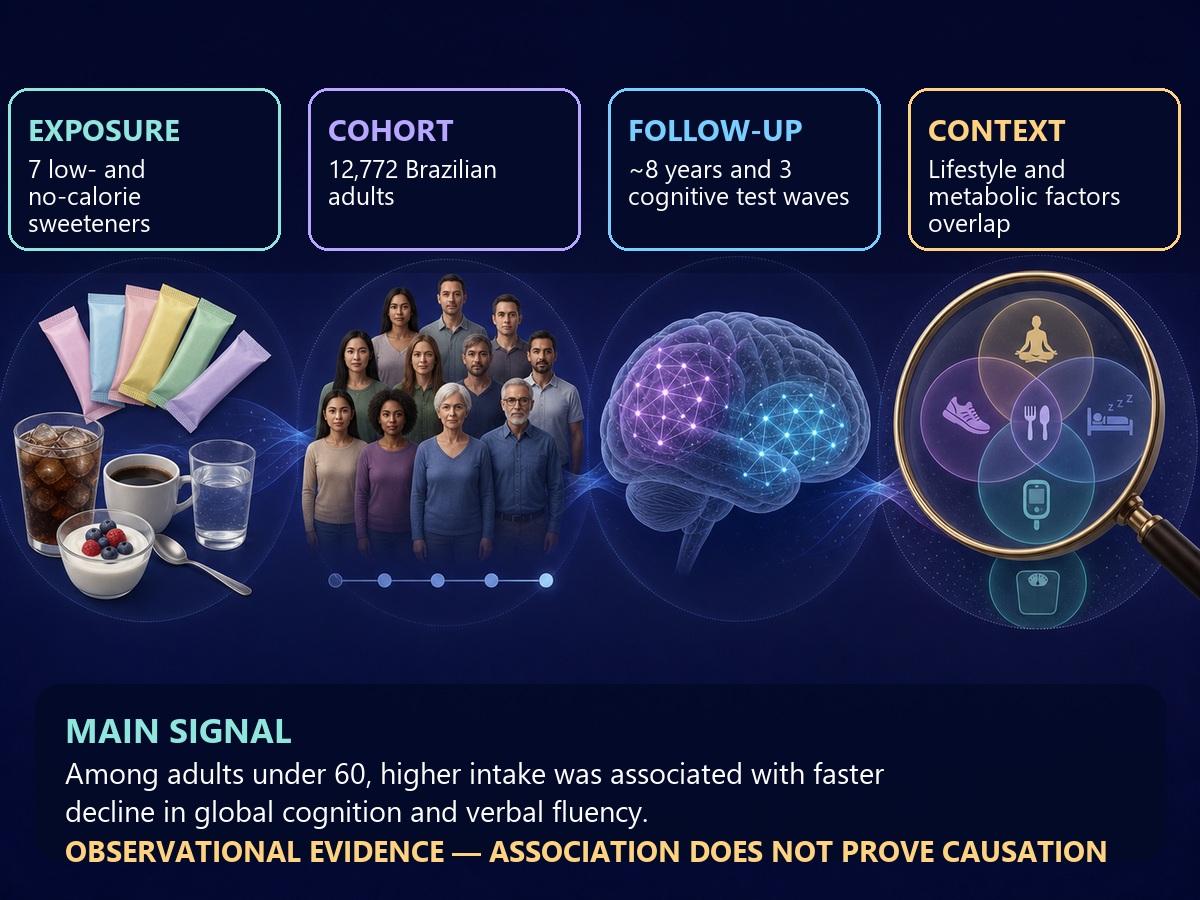
The study followed 12,772 Brazilian adults for roughly eight years in the Brazilian Longitudinal Study of Adult Health. At the beginning, participants were at least 35 years old, with an average age of about 52. They filled out a food-frequency questionnaire, which is the research world's way of asking, with impressive seriousness, 'What do you usually eat?' The investigators estimated intake of seven sweeteners: aspartame, saccharin, acesulfame K, erythritol, xylitol, sorbitol, and tagatose. Participants also took cognitive tests over three waves, including tests of memory, verbal fluency, and overall thinking performance [1].
Here is the result without the fog machine. Among participants younger than 60, people in the higher sweetener-intake groups had faster decline in global cognition and verbal fluency than people in the lowest intake group. Global cognition is a combined score for overall thinking performance. Verbal fluency is the ability to quickly produce words, like naming animals under time pressure, which is easy until your brain offers 'cow, dog, giraffe, uh, the one with the antlers, no, wait.' The study also found signals for several individual sweeteners, including aspartame, saccharin, acesulfame K, erythritol, sorbitol, and xylitol. The same pattern was not clear in participants age 60 and older [1].
Now comes the first bucket we have to kick over. This was not a randomized trial. Nobody was assigned by clipboard-wielding scientists to eight years of diet soda, sugar-free gum, and existential uncertainty. This was an observational cohort study. Researchers watched what people reported eating and drinking, then tracked how their test scores changed. That kind of study is valuable because it can spot patterns in real life. But it cannot prove that sweeteners caused cognitive decline. Association is not causation; yes, the phrase is tired, but it remains annoyingly correct.
Why the fuss about causation? Because people who use more low-calorie sweeteners may differ from people who use less in dozens of ways. They may have different histories of weight gain, diabetes risk, dieting, blood pressure, sleep, exercise, medication use, income, stress, or overall diet quality. The authors adjusted for many factors, which is good. But statistical adjustment is not a magic sponge. Some confounding can remain, especially when the exposure is tangled up with a whole lifestyle, a medical history, and a grocery cart full of other decisions.
The diet measurement also deserves humility. Food-frequency questionnaires are useful for large studies, but they ask humans to remember and estimate their usual intake. Humans, as a species, are not magnificent food-accounting machines. Most of us cannot tell you how much acesulfame K we consumed last Tuesday, because we were busy being alive. The authors noted limitations including self-reported diet, attrition over time, and residual confounding [1]. So the evidence is suggestive, not definitive. It is a flare on the horizon, not a courtroom verdict.
Then there is the regulatory bucket. In the United States, the FDA says authorized sweeteners are safe for the general population under approved conditions of use, and it sets acceptable daily intake levels for approved sweeteners. The FDA also notes that people with phenylketonuria, a rare genetic disorder, need to avoid or restrict aspartame because it contains phenylalanine [2]. That matters. Toxicology limits are not fake. But they answer a narrower question: is this substance considered safe at approved exposure levels? The Neurology study asks a different question: over years, do people with higher habitual intake show different cognitive trajectories? Both questions can exist in the same room without throwing chairs.
Average intakes of low- and no-calorie sweeteners in many populations appear to fall below regulatory acceptable daily intake levels [3]. This is the part where panic should put down its megaphone. Still, a review of the sweetener research landscape found a large but uneven evidence base, with major gaps across long-term health outcomes [4]. Cognitive aging is especially difficult. It unfolds slowly, it depends on vascular health, metabolism, education, sleep, depression, hearing, exercise, and plain luck, and it refuses to sit still while scientists try to isolate one variable. Very rude of it, scientifically speaking.
The Bigger Mess: Packaged Food, Sweetness, and the Brain
One useful way to think about the new paper is to stop staring only at the sweetener molecule and widen the camera lens. Sweeteners often arrive inside ultraprocessed foods and drinks: diet sodas, sugar-free desserts, flavored yogurts, protein bars, gum, low-sugar snacks, and other products engineered to be sweet, convenient, and repeatable. Ultraprocessed foods are industrial formulations made with ingredients and additives you would not usually use in a home kitchen. One serving is not a moral failure. But a diet built heavily around them can crowd out minimally processed foods, fiber, and the slow, boring, heroic stuff like beans and vegetables.
This broader pattern already has cognitive warning signals. In a JAMA Neurology study from the same larger Brazilian cohort, higher ultraprocessed food intake was associated with faster global cognitive decline and faster executive-function decline over about eight years [5]. A separate Neurology study using UK Biobank data found that higher ultraprocessed food consumption was associated with higher dementia risk, while replacing some ultraprocessed food with unprocessed or minimally processed food was associated with lower risk [6]. Again: observational. Again: not proof. But when multiple lines of evidence point toward the same messy neighborhood, it is reasonable to stop pretending the neighborhood is empty.
What might be happening biologically? Here we leave the land of established fact and enter the swampy but interesting territory of plausible mechanisms. Researchers discuss blood-vessel health, insulin resistance, chronic inflammation, gut microbes, appetite regulation, and the way highly processed foods can encourage overconsumption. For sweeteners specifically, some hypotheses involve the gut microbiome or metabolic signaling. But this is preliminary and probably not identical for every sweetener. Aspartame is not erythritol is not sorbitol. Treating all sweeteners as one spooky molecule with seven fake mustaches is bad biology.
Diabetes makes the story even more tangled. In the Neurology study, sweetener intake was associated with faster decline in some cognitive domains among people with and without diabetes, though the patterns differed [1]. But replacing diet drinks with a sugar avalanche is not a brain-health plan. Uncontrolled diabetes is itself a dementia risk factor. The CDC lists physical inactivity, uncontrolled diabetes, high blood pressure, hearing loss, tobacco use, and alcohol use among common dementia risk factors [7]. So the practical question is not 'sweetener or sugar, pick your villain.' It is how to reduce dependence on intense sweetness while protecting metabolic health.
What a Reasonable Human Can Do
The least dramatic and most useful response is to audit your routine. If you use a small amount of sweetener in coffee, that is one thing. If your day runs on several diet sodas, sugar-free snacks, and a dessert that has somehow been made out of fiber syrup and corporate optimism, that is another. Look at labels for aspartame, acesulfame K, saccharin, erythritol, xylitol, sorbitol, and related sweeteners. Do not become a pantry detective with a corkboard and red string. Just notice where the stuff is showing up.
Then make the easy swaps first. Replace one daily sweetened drink, whether sugary or diet, with water, seltzer, unsweetened tea, or coffee you can enjoy less sweet. Choose plain yogurt and add fruit. Keep naturally sweet whole foods, like berries or oranges, in the rotation. If you want dessert, have a smaller portion of something you actually like rather than using 'sugar-free' as permission to keep the sweetness dial turned to stadium-lights bright.
For brain health, the unglamorous fundamentals still have the best footing: move your body, manage blood pressure and diabetes, do not smoke, limit alcohol, protect hearing, sleep enough, and build most meals around minimally processed foods [7]. None of this has the theatrical appeal of discovering one forbidden ingredient responsible for cognitive aging. Unfortunately, biology is a committee meeting, not a murder mystery. The brain is shaped by blood vessels, glucose handling, inflammation, sleep, education, stress, muscles, microbes, and a lifetime of habits, all muttering over one another.
So the bottom line is deliberately unsatisfying, which often means it is closer to true. This Neurology study adds a meaningful warning signal that higher long-term intake of several low- and no-calorie sweeteners may be associated with faster cognitive decline, especially before age 60 [1]. It does not prove that sweeteners cause dementia. It does not mean everyone must quit them tomorrow morning while making a solemn face at the coffee maker. The evidence for cognition is best labeled preliminary-to-suggestive. But if sweeteners have become a major daily habit, especially through ultraprocessed foods and drinks, cutting back is a reasonable, low-drama move. Less sweetness, more whole food, fewer magic bullets. Annoying advice. Often the best kind.
References
[1] Goncalves NG, Martinez-Steele E, Lotufo PA, et al. Association Between Consumption of Low- and No-Calorie Artificial Sweeteners and Cognitive Decline: An 8-Year Prospective Study. Neurology. 2025;105(7):e214023. doi:10.1212/WNL.0000000000214023. PMID: 40902134.
[2] U.S. Food and Drug Administration. Aspartame and Other Sweeteners in Food. Accessed July 20, 2026.
[3] Martyn D, Darch M, Roberts A, et al. Low-/No-Calorie Sweeteners: A Review of Global Intakes. Nutrients. 2018;10(3):357. doi:10.3390/nu10030357. PMID: 29543782.
[4] Lohner S, Toews I, Meerpohl JJ. Health outcomes of non-nutritive sweeteners: analysis of the research landscape. Nutr J. 2017;16(1):55. doi:10.1186/s12937-017-0278-x. PMID: 28886707.
[5] Gomes Goncalves N, Vidal Ferreira N, Khandpur N, et al. Association Between Consumption of Ultraprocessed Foods and Cognitive Decline. JAMA Neurol. 2023;80(2):142-150. doi:10.1001/jamaneurol.2022.4397. PMID: 36469335.
[6] Li H, Li S, Yang H, et al. Association of Ultraprocessed Food Consumption With Risk of Dementia: A Prospective Cohort Study. Neurology. 2022;99(10):e1056-e1066. doi:10.1212/WNL.0000000000200871. PMID: 36219796.
[7] Centers for Disease Control and Prevention. Reducing Risk for Dementia. Updated August 27, 2024. Accessed July 20, 2026.
Scientific & Medical Editorial Standards
Content published by LongevityWiz is developed and reviewed by qualified scientific and medical professionals, including experts holding doctorates in Bioengineering and Immunology and a physician who is a Fellow of the American College of Cardiology (FACC). Our editorial approach emphasizes scientific accuracy, peer-reviewed research, and evidence-based health information. Content is provided for educational purposes only and does not constitute individualized medical advice. Read our full Medical Disclaimer. LongevityWiz does not provide personalized healthcare guidance. Always consult a physician or other qualified healthcare professional before changing your diet, exercise routine, medications, supplements or overall healthcare plan. Never disregard professional medical advice or delay seeking treatment because of information you have read on this website.
.jpg)
