

Coffee's Sweet Spot? What Large UK Studies Really Say About Three Cups, Five Cups, and Your Genes
Jul 22 2026
Edited and Approved by Stephen C. Rose, PhD, MS
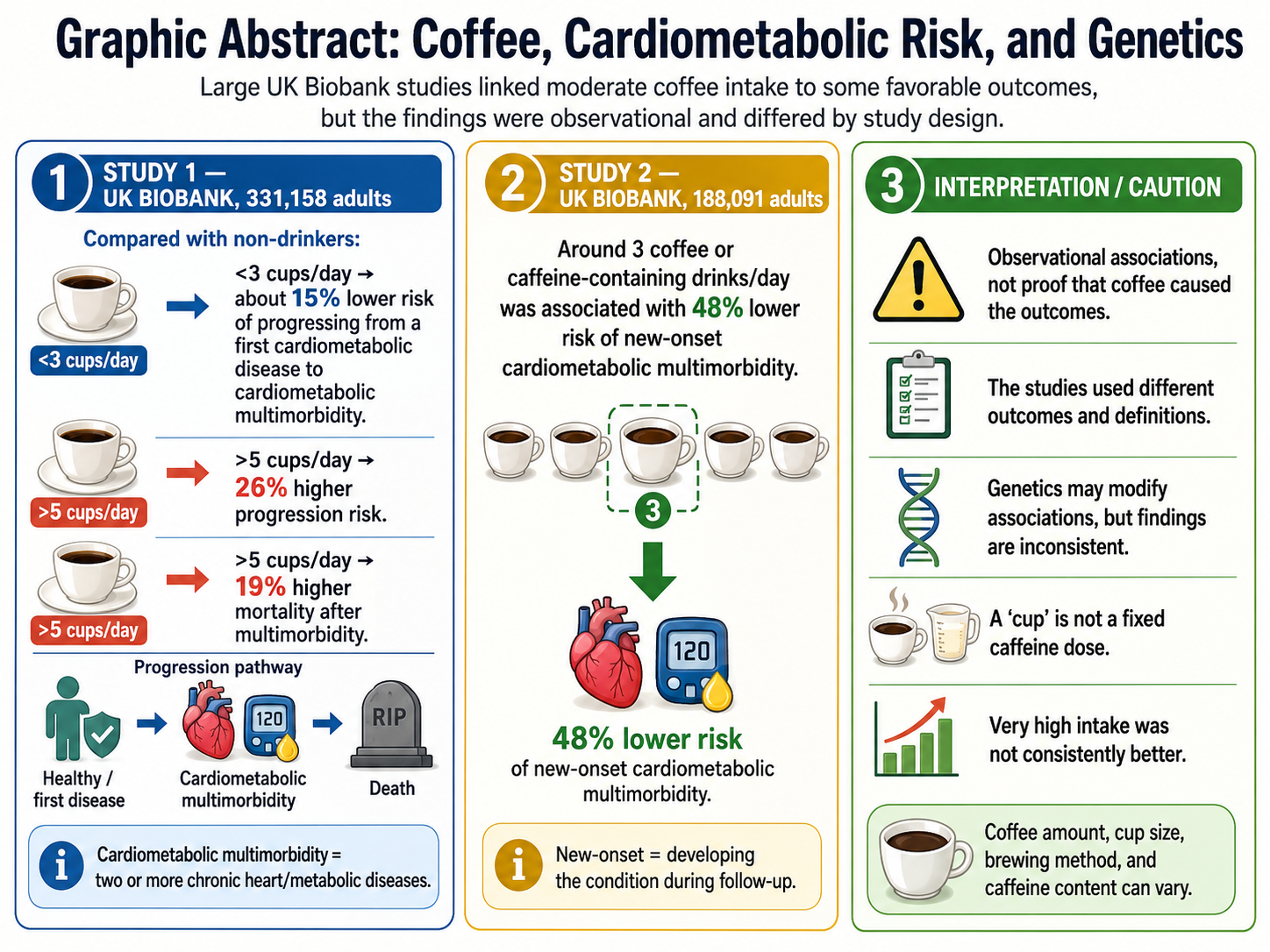
Coffee headlines tend to arrive with the confidence of a barista calling out an order: three cups are good, five cups are bad, and your genes decide the rest. The real evidence is more interesting and less tidy. Two large UK Biobank studies found that moderate coffee intake was associated with lower risks at several stages of chronic disease, while one of them also found higher risks among people drinking more than five cups a day. These were observational findings, not proof that coffee itself caused either outcome [1].
The crucial detail is that the popular 48% figure and the warning about more than five cups came from different studies. They examined different disease groupings and different transitions through illness [1], [2]. Blending them into one smooth dose-response curve creates a stronger story than either paper actually supports. Here is what the researchers found, what remains uncertain, and how to think about your own mug without turning a population study into a prescription.
What the newer study found
The newer analysis, led by Yanghong Xue, followed 331,158 UK Biobank participants who were free at baseline of the four disease groups being studied: type 2 diabetes, cardiovascular disease, cancer, and chronic respiratory disease. During follow-up, 60,616 participants developed a first noncommunicable disease, and 9,938 later progressed to multimorbidity, meaning at least two of those disease groups. Researchers used a multistate model to examine movement from disease-free health to a first disease, then to multimorbidity and death [1].
Compared with non-drinkers, people reporting fewer than three cups a day had about a 15% lower rate of progressing from a first disease to multimorbidity. At the other end, more than five cups a day was associated with a 26% higher rate of that transition. Among people who had reached multimorbidity, more than five cups was also associated with a 19% higher rate of death. These are relative differences in modeled rates, not statements that 15 or 26 people out of every 100 will avoid or develop disease [1].
The infographic's phrase 'people who already had one chronic disease' needs a small correction. Participants entered the study without the specified diseases. The higher-risk result applied to the transition after some participants developed a first disease during follow-up. That distinction matters because the paper was studying a disease trajectory, not simply comparing coffee drinkers who were sick at enrollment [1].
Where the 48% figure came from
A separate study led by Xujia Lu analyzed coffee and tea intake in 188,091 UK Biobank participants who had no cardiometabolic disease at baseline. Here, cardiometabolic multimorbidity had a narrower definition: having at least two of type 2 diabetes, coronary heart disease, and stroke. Over a median follow-up of about 11.7 years, moderate intake showed the lowest observed risk. People reporting around three coffee drinks a day had a hazard ratio of 0.519 compared with non-drinkers, which is the source of the often-quoted 48% lower association [2].
But this study did not show that the benefit reversed beyond five cups. Its highest coffee category, more than 4.5 drinks a day, still had a hazard ratio of 0.660 compared with non-drinkers. Three drinks looked best within the categories tested, but higher intake remained associated with lower new-onset cardiometabolic multimorbidity in that analysis [2]. The 'reversal' belongs to the broader, newer Xue study and to progression after a first chronic disease, not to the 188,091-person result.
Why the studies are not necessarily contradictory
The two papers asked related but different questions. Lu and colleagues focused on diabetes, coronary heart disease, and stroke. Xue and colleagues also included cancer and chronic respiratory disease, then modeled later transitions and mortality. Different outcomes can produce different curves. Coffee might correlate one way with the development of a first cardiometabolic condition and another way with progression in people who have already developed disease. Differences in intake categories, statistical adjustments, and participant subsets matter too [1], [2].
There is broader observational support for a middle-range sweet spot. A major umbrella review found that coffee was more often associated with benefit than harm, with the largest estimated reductions for several outcomes around three to four cups a day [3]. Still, the reviewers emphasized the need for robust randomized trials. Coffee drinkers differ from non-drinkers in smoking, sleep, occupation, diet, income, health awareness, and many other ways. Statistical adjustment helps, but it cannot guarantee that coffee caused the difference.
Genes may matter, but the case is not settled
The Xue study built genetic scores from variants related to caffeine metabolism. With one four-variant score, more than five cups a day was associated with a 54% higher rate of progression from a first disease to multimorbidity in the slowest-metabolism group, compared with 17% in the fastest group [1]. That pattern is biologically plausible: slower clearance can extend caffeine exposure. But it does not mean a consumer DNA test can calculate a safe personal cup limit. These scores are research tools, and the estimates still come from observational subgroup analyses.
Other research has not always found the same gene-by-coffee interaction. A 2019 UK Biobank analysis of up to 347,077 people found modestly higher cardiovascular risk above six cups compared with one to two cups, but no evidence that CYP1A2 or a caffeine-metabolism genetic score changed that association [4]. The outcomes and methods differed, so this is not a direct refutation. It does show that the genetics story remains uncertain rather than established.
A cup is not a fixed dose
A 'cup' in a questionnaire is not a laboratory unit. A small home-brewed coffee, a large cafe drink, instant coffee, espresso, and decaf can deliver very different amounts of caffeine and other compounds. Sugar, cream, brewing method, and drinking time can also change the health context. That makes a five-cup threshold much less precise than it sounds. It also prevents a clean conversion from these studies into milligrams of caffeine for an individual.
For most adults, the U.S. Food and Drug Administration cites 400 milligrams of caffeine a day - roughly two to three 12-fluid-ounce cups of coffee - as an amount not generally associated with negative effects. The FDA also stresses that sensitivity and clearance vary widely, and that pregnancy, medications, and some health conditions may call for lower intake [5]. That safety benchmark is not proof that 400 milligrams improves health, and it is not the same exposure measure used in either UK Biobank paper.
What should a coffee drinker do with this?
If you already enjoy moderate coffee and tolerate it well, these studies do not provide a reason to stop. They also do not provide a reason for a non-drinker to start, or for anyone to push intake toward three cups in pursuit of a 48% reduction. That number describes an association in one cohort, not a guaranteed benefit. The most defensible interpretation is modest: moderate consumption was consistently associated with favorable outcomes, while very high consumption was not reliably better and may be unfavorable in some disease trajectories [1-3].
Pay attention to signals population averages cannot capture. Palpitations, rising blood pressure, anxiety, reflux, tremor, or disrupted sleep are practical reasons to reduce intake even if a graph looks reassuring. People with chronic disease, those taking interacting medications, and anyone who is pregnant or breastfeeding should discuss caffeine with a clinician. Decaffeinated coffee may preserve some non-caffeine compounds, but these studies do not prove it is an equivalent treatment or preventive strategy.
The honest takeaway is less dramatic than the infographic and more useful. Three cups was the lowest-risk category in one large observational study. More than five cups was associated with worse progression in another study using broader diseases and later stages of illness. Genetics might modify that association, but the evidence is not consistent enough for personalized dosing. Moderate coffee can fit comfortably into many people's lives; it should not be mistaken for medicine, and more is not automatically better.
References
[1] Xue Y, Jiang W, Tang Y, et al. Habitual coffee intake, genetic susceptibility and multimorbidity of non-communicable chronic diseases trajectory: a prospective study from UK biobank. Nutr Metab Cardiovasc Dis. 2026;36(1):104288. doi:10.1016/j.numecd.2025.104288. PMID: 40947393.
[2] Lu X, Zhu X, Li G, et al. Habitual Coffee, Tea, and Caffeine Consumption, Circulating Metabolites, and the Risk of Cardiometabolic Multimorbidity. J Clin Endocrinol Metab. 2025;110(6):e1845-e1855. doi:10.1210/clinem/dgae552. PMID: 39287934.
[3] Poole R, Kennedy OJ, Roderick P, et al. Coffee consumption and health: umbrella review of meta-analyses of multiple health outcomes. BMJ. 2017;359:j5024. doi:10.1136/bmj.j5024. PMID: 29167102.
[4] Zhou A, Hypponen E. Long-term coffee consumption, caffeine metabolism genetics, and risk of cardiovascular disease: a prospective analysis of up to 347,077 individuals and 8368 cases. Am J Clin Nutr. 2019;109(3):509-516. doi:10.1093/ajcn/nqy297. PMID: 30838377.
[5] U.S. Food and Drug Administration. Spilling the Beans: How Much Caffeine is Too Much? Consumer Update. Accessed July 22, 2026.
Scientific & Medical Editorial Standards
Content published by LongevityWiz is developed and reviewed by qualified scientific and medical professionals, including experts holding doctorates in Bioengineering and Immunology and a physician who is a Fellow of the American College of Cardiology (FACC). Our editorial approach emphasizes scientific accuracy, peer-reviewed research, and evidence-based health information. Content is provided for educational purposes only and does not constitute individualized medical advice. Read our full Medical Disclaimer. LongevityWiz does not provide personalized healthcare guidance. Always consult a physician or other qualified healthcare professional before changing your diet, exercise routine, medications, supplements or overall healthcare plan. Never disregard professional medical advice or delay seeking treatment because of information you have read on this website.

