

Can an Enzyme Undo One Kind of Protein Aging?
Jul 15 2026
Edited and Approved by Stephen C. Rose, PhD, MS
Aging biology has a wonderfully unfair habit: just when you think the plot is about genes, stem cells, or mitochondria, it points to something duller and more physical, like old proteins quietly getting chemically scuffed. The new Nature Communications paper from Trabosh and colleagues is about exactly that sort of damage, and its central claim is preliminary but genuinely interesting: an engineered enzyme called CMLase can remove a common aging-related protein modification called N-epsilon-carboxymethyl-lysine, or CML, from model proteins and from aged human tissue samples outside the body [1]. That is not the same as rejuvenating a person. Let us pin that sentence to the lab bench before it escapes in a tiny white coat. But it is a proof of concept for enzymatic repair of a type of molecular wear once treated as essentially irreversible.
CML belongs to the large family of advanced glycation end products, usually shortened to AGEs. These form when sugars or sugar-derived reactive molecules bump into proteins and alter amino acids without the tidy supervision of enzymes. The chemistry is established; the biological meaning is messier. AGEs accumulate in diabetes and aging, especially on long-lived proteins, and have been studied for decades as contributors to tissue stiffness, inflammation, and metabolic trouble [2]. The popular cartoon version is that sugar simply caramelizes the body. That is vivid, but too cute. The real story is a slow traffic jam of reactive carbonyl chemistry, protein turnover, tissue architecture, immune signaling, and time doing what time does best: refusing to leave.
Why does CML matter in particular? First, it is chemically stable. Once it is installed on lysine, one of the amino acids in proteins, ordinary cleanup systems have a hard time reversing it. Second, CML is found in aging human tissues and has been used as a marker of long-term glycemic damage [3]. Third, it can interact with RAGE, the receptor for advanced glycation end products, which is one route by which damaged-looking molecules may stir inflammatory signaling. That does not make CML the master villain of aging. Aging does not have a master villain; it has a committee, and the committee meets constantly. The evidence that CML participates in age-related dysfunction is substantial but still context-dependent.
What the New Study Did
The researchers started with a hard engineering problem. No convenient natural enzyme was known to cut CML off peptides and proteins in the desired way. So they looked for a scaffold, a starting protein with a vaguely useful talent. They chose glycine oxidase, reasoning that part of CML resembles glycine closely enough that the enzyme might be coaxed into useful misbehavior. Then came directed evolution: make many variants, test them, keep the better ones, and repeat. In the paper, that meant screening and evolving across more than 500 million variants until they produced CrGO-897, which they call CMLase [1].
In biochemical terms, CMLase oxidizes CML and restores the native lysine residue. In plain English, the enzyme tries to erase one particular chemical smudge and put the original amino acid back. That is a more elegant idea than merely blocking future damage. Previous AGE strategies have often focused on trapping reactive precursors or breaking selected cross-links; useful concepts, but not the same as repairing a stable single-residue modification after it has already accumulated. Here the researchers tested CMLase on free CML, CML-modified peptides, and several full-length protein substrates. The result was preliminary but direct: the enzyme reduced CML signals across multiple proteins, with the degree of repair varying by substrate and site [1].
That variability matters. Proteins are not limp strings floating politely in a beaker. They fold, pack, hide residues, expose others, bind neighbors, and generally behave like tiny architectural problems with attitude. The study found that CMLase did not repair every CML site equally. Some sites looked accessible; others resisted. This is not a defect in the logic of the work so much as biology waving its arms and saying, again, that shape matters. Any future therapeutic version would need to reach the damaged residues inside real tissues, not just behave nicely in controlled assays.
The Human Tissue Result
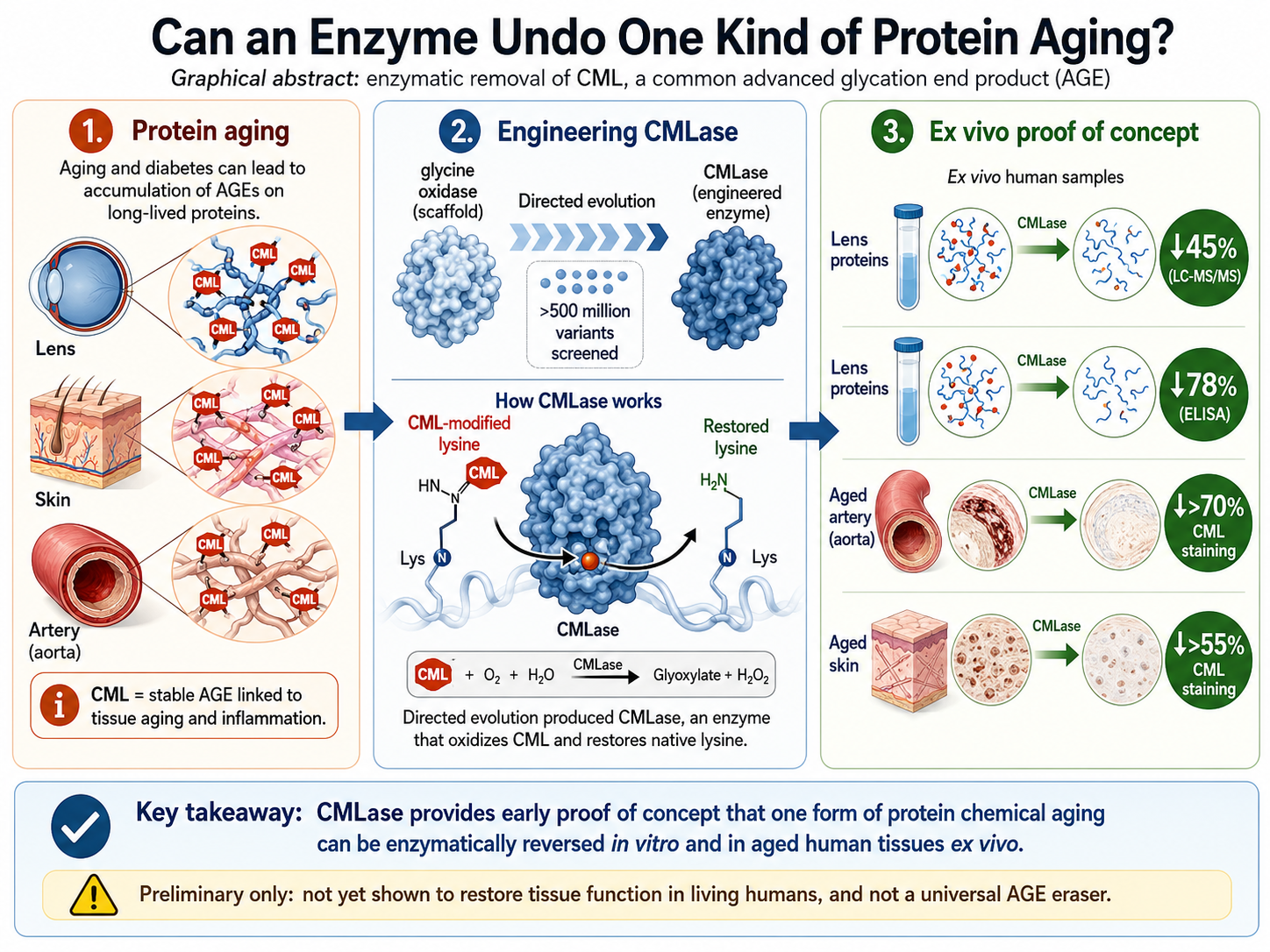
The most striking part of the paper was the ex vivo human tissue work. The team tested CMLase on proteins from a 64-year-old human lens and on tissue sections from skin and abdominal aorta. Lens crystallins are among the longest-lived proteins in the body, which makes them excellent little museums of accumulated chemical indignities. In soluble lens proteins, CMLase reduced total CML by 45% using LC-MS/MS and by 78% using an ELISA assay, a difference the authors interpret as likely reflecting accessible versus buried CML pools [1]. That is promising, but it is still a chemical measurement, not a restored visual system.
In aged arterial and skin sections, the authors used immunohistochemistry to stain for CML before and after enzyme treatment. CMLase treatment reduced staining by more than 70% in elderly arterial tissue and by more than 55% in elderly skin tissue [1]. Again, impressive, but ex vivo. Thin, fixed tissue sections are not living organs with blood flow, immune surveillance, barriers, and awkward three-dimensional plumbing. The evidence here is best labeled preliminary and mechanistic. It says the chemistry can be reversed in complex human tissue samples. It does not yet say that a treatment can safely improve artery elasticity, skin function, lens transparency, or any clinical outcome.
This is where the distinction between damage repair and functional rejuvenation becomes crucial. Aging researchers have long known that extracellular matrix proteins, including collagen, accumulate chemical changes over time. Some of the most stubborn modifications are cross-links such as glucosepane, which has been identified as a major protein cross-link in senescent human extracellular matrix and is increased in diabetes [4]. CMLase targets CML, not glucosepane. So the study is not a universal AGE eraser. It is more like finding one working key on a ring full of locks. That is still important, because one working key proves the doors are not all painted on.
What It Does Not Prove
The authors are appropriately cautious about translation. They note that future work must test whether chemical reversal produces functional restoration, whether the enzyme can penetrate dense living extracellular matrix, and whether a bacterial-origin enzyme can be made safe enough for repeat use [1]. Those are not administrative details. They are the difference between an elegant experiment and a medicine. Enzymes can trigger immune responses. They can have off-target activity. They can fail to reach the right compartment. They can work beautifully in a dish and then discover, upon entering a body, that the body has opinions.
There is also a causality issue. AGEs, RAGE signaling, oxidative stress, and inflammation are tied together in many studies, including work showing that CML can drive age-related oxidative stress and mitochondrial damage in microglia through gut-microbiota-linked metabolism [5]. But association and mechanism do not automatically tell us how much benefit will come from removing one lesion in one tissue at one age. The established point is that AGEs and CML are biologically relevant. The uncertain point is how much repair of CML alone changes human physiology.
The glyoxalase system adds another useful comparison. Cells already have machinery to detoxify methylglyoxal, a highly reactive dicarbonyl compound implicated in diabetes complications and other age-related diseases [6]. But detoxifying precursors is not the same as reversing stable AGE marks after they are written into long-lived proteins. CMLase therefore occupies a different conceptual category: repair after the fact. If future versions can be made safe, targeted, and effective in living tissue, this strategy could become a tool for testing whether removing defined chemical scars changes tissue aging in a measurable way.
The sober takeaway is neither miracle nor shrug. This study provides early evidence that at least one form of protein chemical aging can be enzymatically reversed under experimental conditions, including in aged human tissue samples [1]. It also exposes the next mountain range: delivery, specificity, immune safety, tissue penetration, functional recovery, and clinical relevance. Biology, being biology, has declined to make this easy. Still, the paper nudges the field from merely cataloging molecular damage toward repairing it. That is a real conceptual move, even if the therapeutic road ahead is long, bumpy, and almost certainly littered with experiments that will need to be cleaned up after themselves.
References
[1] Trabosh N, Smith J, Hsu MYH, Panja S, Nagaraj R, Olsson N, McAllister FE, Cravens A. Reversal of protein chemical aging by enzymatic deglycation. Nature Communications. 2026;17:5926. doi:10.1038/s41467-026-75141-2. PMID: 42448719.
[2] Ulrich P, Cerami A. Protein glycation, diabetes, and aging. Recent Progress in Hormone Research. 2001;56:1-21. PMID: 11237208.
[3] Monnier VM, Genuth S, Sell DR. The pecking order of skin Advanced Glycation Endproducts (AGEs) as long-term markers of glycemic damage and risk factors for micro- and subclinical macrovascular disease progression in Type 1 diabetes. Glycoconjugate Journal. 2016;33:569-579. PMID: 27342131.
[4] Sell DR, Biemel KM, Reihl O, Lederer MO, Strauch CM, Monnier VM. Glucosepane is a major protein cross-link of the senescent human extracellular matrix. Relationship with diabetes. Journal of Biological Chemistry. 2005;280:12310-12315. PMID: 15677467.
[5] Mossad O, Batut B, Yilmaz B, Dokalis N, Mezö C, Nent E, et al. Gut microbiota drives age-related oxidative stress and mitochondrial damage in microglia via the metabolite N6-carboxymethyllysine. Nature Neuroscience. 2022;25:295-305. PMID: 35228770.
[6] Schalkwijk CG, Stehouwer CDA. Methylglyoxal, a Highly Reactive Dicarbonyl Compound, in Diabetes, Its Vascular Complications, and Other Age-Related Diseases. Physiological Reviews. 2020;100:407-461. PMID: 31487237.
Scientific & Medical Editorial Standards
Content published by LongevityWiz is developed and reviewed by qualified scientific and medical professionals, including experts holding doctorates in Bioengineering and Immunology and a physician who is a Fellow of the American College of Cardiology (FACC). Our editorial approach emphasizes scientific accuracy, peer-reviewed research, and evidence-based health information. Content is provided for educational purposes only and does not constitute individualized medical advice. Read our full Medical Disclaimer. LongevityWiz does not provide personalized healthcare guidance. Always consult a physician or other qualified healthcare professional before changing your diet, exercise routine, medications, supplements or overall healthcare plan. Never disregard professional medical advice or delay seeking treatment because of information you have read on this website.

