

Inflammation, Insulin Resistance, and Heart Risk: What the New CTI Score May Reveal
Jul 30 2026
A new composite score links inflammation and insulin resistance with cardiovascular risk—but it remains an early, observational signal.
Edited and Approved by Stephen C. Rose, PhD, MS
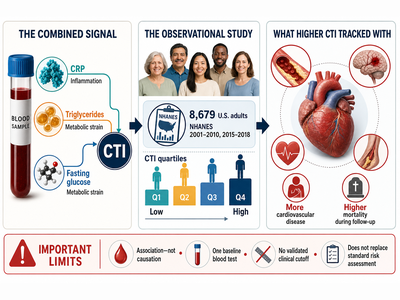
Heart disease rarely comes from a single broken switch. It usually develops through several interacting problems: blood pressure, cholesterol, smoking, blood-sugar control, body composition, inflammation, genetics, and time. A 2025 study asked whether combining two of those signals, inflammation and insulin resistance, might reveal cardiovascular risk more clearly than looking at either one alone [1]. The proposed measure is called the C-reactive protein-triglyceride glucose index, mercifully shortened to CTI.
The result is intriguing. Among 8,679 U.S. adults, people with higher CTI values were more likely to report cardiovascular disease and were more likely to die during follow-up. But this was an observational analysis, not a clinical trial. It cannot show that CTI itself causes heart disease, that lowering the score prevents a heart attack, or that CTI should replace established risk calculators. For now, CTI is best understood as a preliminary risk signal and a useful window into how metabolism and inflammation may travel together.
What is CTI actually measuring?
CTI combines C-reactive protein, or CRP, with the triglyceride-glucose index, usually called TyG. CRP is made by the liver when inflammatory signaling rises. It can increase during an infection or injury, but persistently higher levels may also reflect the low-grade inflammation associated with obesity, metabolic dysfunction, and cardiovascular disease. TyG is calculated from fasting triglyceride and glucose values. It was developed as an accessible surrogate for insulin resistance, the state in which cells respond less effectively to insulin [2].
Insulin resistance can push glucose and triglycerides upward and often clusters with abdominal obesity, high blood pressure, and abnormal cholesterol. TyG has therefore attracted interest as an inexpensive cardiometabolic marker, although it is not a perfect substitute for direct measurements of insulin sensitivity and its ideal cutoff varies by population [3]. CTI attempts to widen the lens: instead of viewing metabolic strain and inflammation as separate lanes, it places them in one numerical score.
That biological idea is plausible. A meta-analysis of 33 observational studies found that several inflammatory markers, including CRP, were associated with later cardiovascular disease [4]. Inflammation can influence artery walls, blood clotting, and plaque behavior, while insulin resistance can worsen glucose regulation, lipid handling, and vascular function. Still, a plausible mechanism does not prove that a new equation improves medical decisions.
What the new study found
The researchers analyzed adults from multiple cycles of the National Health and Nutrition Examination Survey, or NHANES, spanning 2001-2010 and 2015-2018. Participants needed CRP, fasting triglyceride, fasting glucose, outcome, and covariate data. The investigators divided CTI values into four groups and adjusted their statistical models for age, sex, race, education, smoking, alcohol use, blood pressure, body mass index, LDL and HDL cholesterol, hemoglobin A1c, diabetes, and hypertension [1].
Compared with the lowest CTI group, the highest group had a reported 2.28-fold hazard of cardiovascular death and a 2.14-fold hazard of death from any cause. The highest group also had higher odds of total cardiovascular disease, heart failure, coronary heart disease, angina, heart attack, and stroke. The relationships were broadly similar across sex and age groups. Curiously, the association with cardiovascular disease appeared in participants without diagnosed diabetes but not in those with diabetes.
These are relative comparisons, not forecasts of an individual's absolute risk. A doubling of relative risk can mean very different things when the starting risk is one in a thousand versus one in ten. The paper did not establish a CTI threshold that tells a particular patient what will happen, nor did it show how many people would be reclassified correctly if CTI were added to a standard cardiovascular assessment. That distinction matters because a marker can be statistically associated with disease yet add little practical information beyond measurements clinicians already use.
Those numbers sound dramatic, but they need context. People in the higher CTI groups were older and were more likely to smoke, have hypertension or diabetes, carry more body weight, and have less favorable cholesterol and blood-sugar measures. Statistical adjustment can reduce the influence of measured differences, but it cannot remove every unmeasured difference. CTI may be identifying a cluster of existing risks rather than a new, independent biological pathway.
Why the evidence is interesting but not causal
Other research supports parts of the pattern. In a prospective cohort of nearly 50,000 adults, higher TyG levels and greater change in TyG over time were independently associated with later cardiovascular disease [5]. A separate national cohort of 8,658 middle-aged and older Chinese adults found the highest cardiovascular risk among people who had both higher TyG and higher high-sensitivity CRP [6]. These studies make the combined metabolic-inflammatory signal more credible, but they remain observational.
Causality becomes even less certain when genetics are considered. In a study of more than 112,000 people, higher CRP and glucose predicted ischemic heart disease and cardiovascular death, yet Mendelian-randomization analyses did not support a direct causal effect of CRP on glucose or glucose on CRP [7]. In plain language, two warning lights can illuminate the same underlying engine trouble without one warning light causing the other or causing the breakdown.
The CTI paper also contains an internal reporting issue worth noting. Its narrative states that 1,152 participants died from all causes and 360 died from cardiovascular causes, but a main results table appears to reverse those outcome labels. The hazard ratios reported in the abstract follow the table labels. That discrepancy does not erase the overall association, but it means the exact mortality estimates should be interpreted cautiously unless the authors or journal clarify the labeling.
What CTI cannot tell you yet
CTI was calculated from a single baseline blood draw. CRP can rise temporarily after infection, injury, or strenuous exercise, so one measurement may not represent a person's usual inflammatory state. Cardiovascular conditions were largely identified through self-report, which can miss undiagnosed disease and blur the timing of onset. Although the authors described cardiovascular incidence, their logistic models primarily assessed whether disease was present in the survey data, limiting conclusions about what developed later.
The study also excluded many NHANES participants who lacked the required laboratory, outcome, or covariate data. That can produce selection bias if the included group differs systematically from the people left out. There was no external validation cohort, no direct comparison showing that CTI improves prediction beyond standard tools, and no intervention that lowered CTI and measured whether outcomes improved. The evidence is therefore preliminary for clinical use.
What this means for your health
CTI is not a do-it-yourself diagnosis, and there is no universally accepted healthy target. Its formula depends on specific units and logarithmic calculations, and a high value does not identify which component deserves treatment. Clinicians already have validated ways to assess cardiovascular risk using age, blood pressure, cholesterol, diabetes, smoking history, kidney health, family history, and, when appropriate, additional tests.
The practical message is less exotic: inflammation and metabolic health are connected parts of long-term cardiovascular resilience. Regular activity, avoiding tobacco, adequate sleep, a dietary pattern rich in minimally processed plants, weight management when appropriate, and evidence-based treatment of blood pressure, cholesterol, and diabetes can address established risks. A clinician may order CRP or other tests in selected situations, but CTI has not yet earned a place as a routine screening test.
For longevity science, CTI is valuable because it captures a larger idea. The most informative biomarkers may not be isolated snapshots; they may be combinations that reveal interactions among biological systems. The next step is prospective validation across diverse populations, followed by studies asking whether CTI improves decisions beyond existing risk scores. Most importantly, researchers must determine whether changing the score changes outcomes. Until then, CTI is a promising map of risk, not a treatment target and not a verdict.
References
[1] Sun Y, Guo Y, Ma S, Mao Z, Meng D, Xuan K, et al. Association of C-reactive protein-triglyceride glucose index with the incidence and mortality of cardiovascular disease: a retrospective cohort study. Cardiovasc Diabetol. 2025;24(1):313. doi:10.1186/s12933-025-02835-0.
[2] Simental-Mendía LE, Rodríguez-Morán M, Guerrero-Romero F. The product of fasting glucose and triglycerides as surrogate for identifying insulin resistance in apparently healthy subjects. Metab Syndr Relat Disord. 2008;6(4):299-304. doi:10.1089/met.2008.0034.
[3] Tao LC, Xu JN, Wang TT, Hua F, Li JJ. Triglyceride-glucose index as a marker in cardiovascular diseases: landscape and limitations. Cardiovasc Diabetol. 2022;21(1):68. doi:10.1186/s12933-022-01511-x.
[4] Liu Y, Guan S, Xu H, Zhang N, Huang M, Liu Z. Inflammation biomarkers are associated with the incidence of cardiovascular disease: a meta-analysis. Front Cardiovasc Med. 2023;10:1175174. doi:10.3389/fcvm.2023.1175174.
[5] Li H, Zuo Y, Qian F, Chen S, Tian X, Wang P, et al. Triglyceride-glucose index variability and incident cardiovascular disease: a prospective cohort study. Cardiovasc Diabetol. 2022;21(1):105. doi:10.1186/s12933-022-01541-5.
[6] Cui C, Liu L, Qi Y, Han N, Xu H, Wang Z, et al. Joint association of TyG index and high sensitivity C-reactive protein with cardiovascular disease: a national cohort study. Cardiovasc Diabetol. 2024;23(1):156. doi:10.1186/s12933-024-02244-9.
[7] Rolver MG, Emanuelsson F, Nordestgaard BG, Benn M. Contributions of elevated CRP, hyperglycaemia, and type 2 diabetes to cardiovascular risk in the general population: observational and Mendelian randomization studies. Cardiovasc Diabetol. 2024;23(1):165. doi:10.1186/s12933-024-02207-0.

